





Performance Optimization
Shopify Plus Scripts vs Shopify Functions: Key Differences
Mohammad Aamir|Oct 22, 2025|Read 14 Min



Adobe Commerce and Adobe Experience Manager are both popular platforms used by businesses to create a strong digital presence in the eCommerce arena. While both platforms are from the Adobe ecosystem, they serve very different purposes. AEM is a powerful content management system (CMS) for delivering engaging user experiences, whereas Adobe Commerce excels in managing online stores and facilitating transactions, offering a comprehensive eCommerce solution.
In this blog, we explore the difference between AEM and Adobe Commerce, and help businesses identify the right fit for them.
AEM or Adobe Experience Manager is a Content Management System (CMS), and part Digital Asset Management (DAM) system that helps businesses control their content spread across different channels – hassle free. It serves as a one stop solution for content creation, management and optimization for websites, mobile apps and digital forms. The platform aces at handling complex content workflows, digital asset management, and personalized content delivery.
Besides, AEM seamlessly integrates with other Adobe Marketing Cloud products, such as Analytics and Target, for enhanced marketing strategies.
Time-sensitive for current AEM users: Adobe ended support for AEM 6.5 LTS on August 31, 2026. Businesses still running that version should prioritize migrating to AEM as a Cloud Service to maintain security support and access to newer features.
Adobe Commerce is a full-fledged eCommerce platform aimed to help businesses build, manage and scale their online store. It comes with a suite of features for product management, order processing, customer segmentation, and marketing automation. It is an ideal solution for businesses to create exceptional shopping experiences and drive online sales.
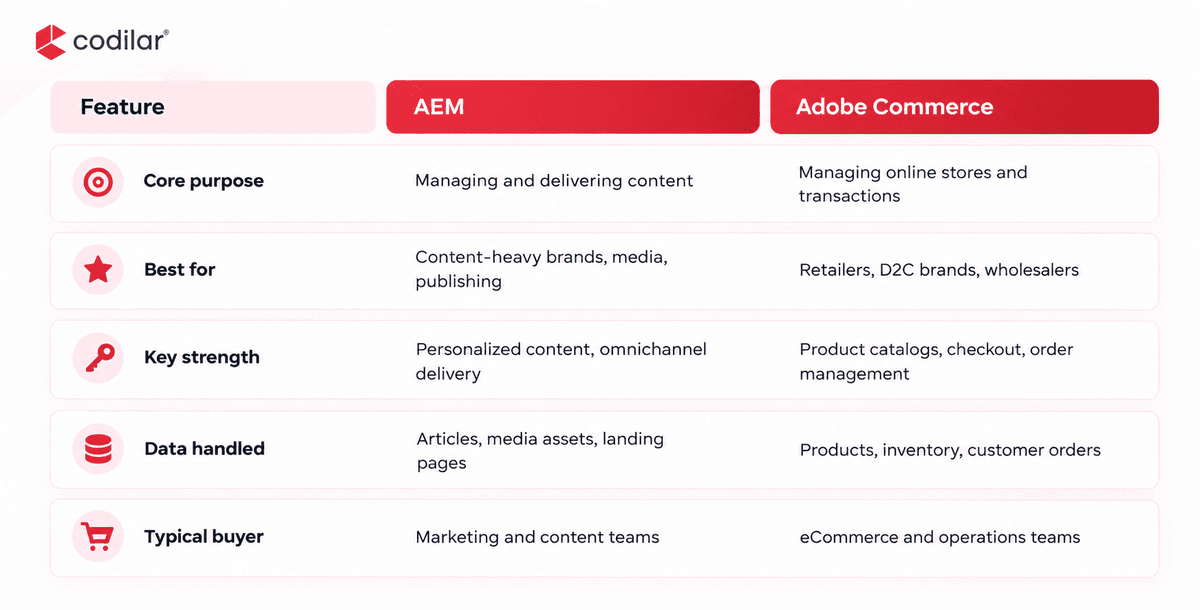
While both platforms fall under Adobe's ecosystem and can integrate deeply with each other, they solve fundamentally different problems.
AEM answers "how do we tell our story and engage customers with content," while Adobe Commerce answers "how do we sell products and process transactions efficiently."
Many enterprise brands use both together, letting AEM's content capabilities enhance the shopping experience Adobe Commerce powers underneath.
AEM, Adobe Commerce or Both? In order to answer this, your business goals must be prioritized. Each platform serves a unique purpose, and the right choice depends on your business requirements, whether its content, eCommerce, or a seamless blend of both.
The integration itself has a name: Adobe's Commerce Integration Framework (CIF), which connects AEM to Adobe Commerce using GraphQL APIs. This lets AEM directly pull in product data, catalog content, and pricing from Adobe Commerce, so content authors can build rich, editorial-style pages around live product data without leaving AEM. Adobe has also introduced newer "Commerce drop-in components" as part of AEM's Edge Delivery approach, giving businesses more flexibility in how deeply they integrate the two platforms.
For businesses looking for an integrated customer experience combining AEM with Adobe Commerce offers the best of both worlds! This powerful duo enables businesses to unify their content and eCommerce strategies, ensuring a high-quality and consistent customer experience on all fronts.
Given that Adobe Commerce is a popular digital solution adopted by most retailers and businesses, AEM integration can surely enhance their digital experience.
Partnering with an Adobe Commerce development company or an AEM development agency ensures you get the expertise needed to fully leverage these platforms. Whether you’re looking to enhance customer engagement, optimize content delivery, or build a seamless omnichannel experience, the right implementation partner can help you maximize the potential of AEM and Adobe Commerce.
For basic content needs, Adobe Commerce's Page Builder and CMS blocks may be enough. AEM becomes worthwhile once you need advanced authoring, multi-site management, localization workflows, or asset management beyond what Commerce offers natively.
Developer involvement is typically required. The Commerce Integration Framework (CIF) uses GraphQL APIs and requires configuration to connect the two platforms properly, it's not a simple toggle.
Yes, this is time-sensitive. Adobe ended support for AEM 6.5 LTS on August 31, 2026, so staying on it means missing security patches. Migrating to AEM as a Cloud Service should be a near-term priority.
It depends on how content-driven your business is. If product storytelling, personalization, and multi-channel content genuinely drive your revenue, the combined cost can pay off. If you just need a functional storefront, Adobe Commerce's built-in content tools may be sufficient on their own.
Yes. Both platforms support API-first architecture, AEM can serve as a headless CMS feeding content into a custom storefront, while Adobe Commerce's GraphQL APIs handle the transactional side, a common setup for advanced enterprise builds.

Get tailored technology solutions to scale your retail business online
Request A Quote

Stay ahead with insights, trends, and brand success stories from the world of Digital Commerce.


DTECH, Techno Hub 1, Dubai Silicon Oasis Authority, United Arab Emirates - Dubai - United Arab Emirates

Level 1, Building 7, Zone A Airport road, Business Gate P.O Box 93597 Riyadh 11683, KSA.


Codilar Digital Pte Ltd, 68 Circular Road, #02-01, 049422, Singapore

7th Floor, Jupiter Block Prestige Tech Park, Kadubeesanahalli, Bellandur Amtankere, Bengaluru, Karnataka 560103

Satrio Tower, Floor 6, Unit C and D, Desa/Kelurahan Kuningan Timur, Kec. Setiabudi, Kota Adm. Jakarta Selatan, Provinsi DKI Jakarta