




General
eCommerce Website Development for Pet Care Brands in the UAE
Aakash Ashok|Oct 16, 2026|Read 8 Min



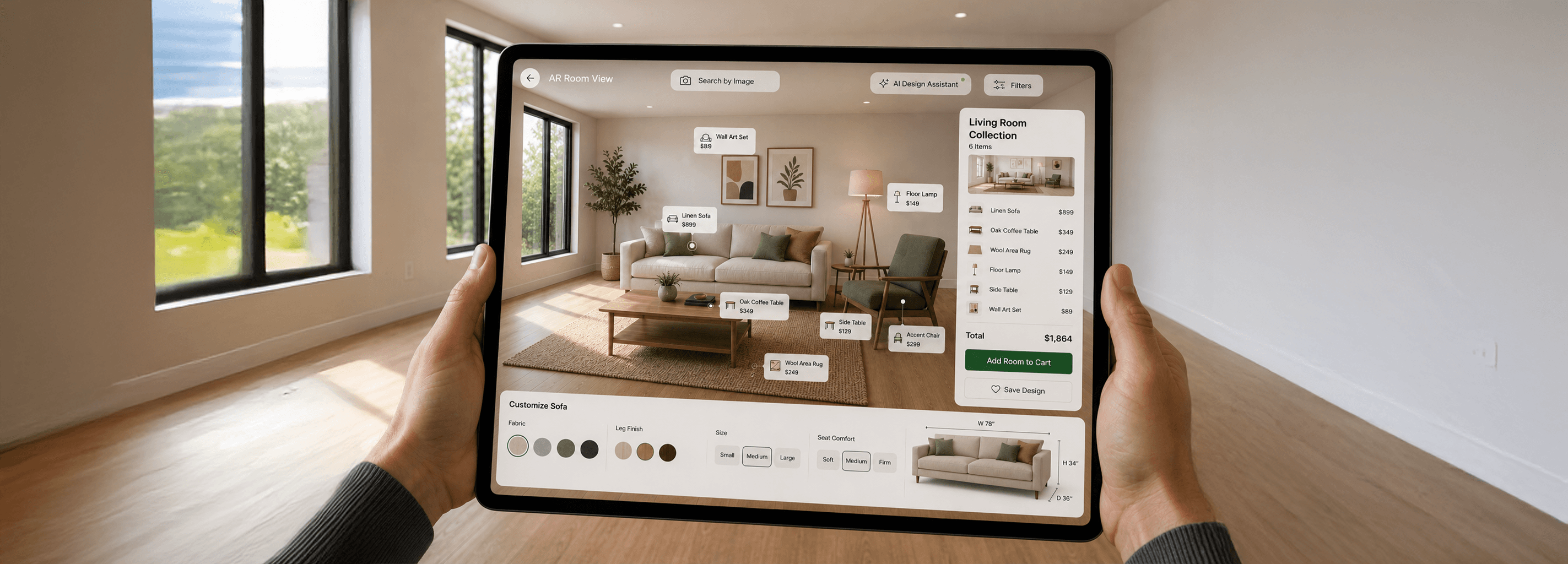
In 2026, home has become the primary canvas for self-expression. Driven by sustained remote work, a generational shift toward values-based spending, and a growing appetite for sustainable and design-forward living, consumers are investing in their spaces more deliberately than at any point in the past decade. That investment is increasingly happening online, where the discovery journey begins on a social feed, moves through inspiration and comparison, and ends at a checkout.
Quick Catchup: "The global home decor market reaches $716.53 billion in 2026, with online channels projected to overtake offline sales for the first time."
Home decor eCommerce website development in 2026 demands far more than a visually appealing storefront. The category converts at just 1.4% online, the lowest of any major eCommerce vertical. Visualization tools, AI personalization, performance infrastructure, and marketing strategy all have to work as one system, not as separate decisions made at different stages of a build.
Check this guide to understand what platform suits your brand, what technology drives conversion in this category, and what it genuinely takes to build a home decor store that performs in 2026.
Home decor is no longer a category where consumers browse casually and buy occasionally. In 2026, it has become an active, ongoing expression of identity, primarily driven by remote work, a generational shift toward values-based spending, and a design culture shaped almost entirely by social media. The result is a market that is growing fast, moving online faster, and becoming more demanding of the brands competing within it.
Latest home decor trends:
Three forces are defining the category in 2026, including:
The premium segment is growing fastest, with affluent consumers purchasing designer furniture, bespoke textiles, and exclusive collections through digital channels.
Understanding why consumers choose to buy decor for the home online is essential for any brand building a digital store in this category. Home decor purchases are high-consideration and deeply personal. The decision process is longer, the return rate is higher, and the emotional stakes are greater than in most retail categories. Yet the shift online is accelerating and the reasons are specific and commercially useful to know.
Platform selection for home decor eCommerce carries requirements that most general retail platforms were not originally designed to handle. Large-file imagery, 3D model support, AR integration, complex variant management across materials and finishes, and high-consideration purchase flows all demand specific platform capabilities.
The platform is the strongest beginning for most D2C home decor brands in 2026. For instance, Ruggable scaled from startup to over $100M in revenue on Shopify, crediting checkout extensibility and speed improvements for direct conversion and SEO gains. Shopify Plus supports native AR via Shopify AR, a robust app ecosystem for 3D visualization, and the fastest time to market of any enterprise platform.
Built for brands managing catalogs with thousands of variants across materials, dimensions, colors, and finishes, alongside B2B wholesale and D2C operations simultaneously. Launched in 2025, Adobe Commerce (Magento) as a Cloud Service, adds a multi-tenant SaaS deployment option that reduces infrastructure overhead for enterprise brands.
Headless or composable commerce is for brands needing full creative control over room visualization tools, 3D configurators, and AI design assistants without platform constraints. Shopify's Hydrogen and Oxygen stack supports headless builds with Shopify's backend reliability. Brands like Ruggable have used headless setups to create fast, content-rich, and performance-optimized storefronts.
Free eCommerce options for home decor brands exist through Shopify's free themes and open-source Magento, though AR integrations, 3D viewer apps, and hosting costs apply regardless of the license.
Ready to build a home decor store that converts browsers into buyers? Talk to Codilar’s expert today.
Home decor requires technology that no other retail category demands at the same depth. The 1.4% average conversion rate is due to shoppers not able to see how a product will look in their space. The features below are the 2026 answer to that problem, and several others that follow from it.
All of these features depend on clean, structured product data underneath. Dimensions, materials, style categories, room compatibility, and sustainability attributes must be accurate and machine-readable, both for AI-driven personalization and for the product schema that determines visibility in Google and AI agent searches.
Home decor purchases are made emotionally before they are justified rationally. A shopper does not decide to buy a rug because the product specification is compelling. They decide because they can picture it in their living room, because it reflects something about how they want their home to feel, and because the brand experience they encountered built enough trust to make the transaction feel safe. UX and visual design are where all three of these conditions are either created or lost.
With 63% of Wayfair orders arriving via mobile, the entire experience must be designed for a screen most shoppers are holding with one hand. Fast-loading high-resolution imagery, intuitive room navigation, and a checkout that surfaces delivery timelines and return policies before the final step are the baseline. Home decor pages are structurally the most image-heavy in eCommerce, making LCP the most common ranking and conversion bottleneck. AVIF formats, preloaded hero assets, and a CDN-backed hosting environment are what keep a visually ambitious store commercially competitive.
Home decor is one of the most visually dependent categories in retail, which makes it one of the most naturally suited to social commerce. The brands pulling ahead in 2026 are not simply posting more but the ones who are operating with a structured marketing playbook.
Home decor is operationally one of the most complex eCommerce categories. The same brand can be shipping a $28 decorative accessory via standard courier and a $2,400 sofa requiring white-glove delivery, assembly, and packaging removal, all from the same platform. Getting operations wrong in this category does not just create a bad customer experience but creates reviews following a brand for years. The following are the primary operational considerations:
Home decor has a unique SEO structure that most brands are not fully exploiting. Style guide content targeting queries like "minimalist living room ideas 2026" or "Scandinavian bedroom decor" captures high-volume informational searches and links naturally back to product pages. Room-specific and style-specific long-tail keywords convert at a significantly higher rate than generic category terms. In 2026, that same content now needs to serve AI, including:
The home decor brands closing the gap on 1.4% industry conversion rate are not doing it with a single well-chosen feature or a strong social strategy in isolation. They are building AR visualization, AI personalization, marketing, operations, SEO, and performance as one connected system, and building their store around that reality from the start. In 2026, with AI agents completing purchases on behalf of shoppers and consumer expectations continuing to rise.
Codilar Technologies has spent years building and scaling home decor eCommerce stores for global brands, with over 240 specialists working across Magento, Shopify Plus, AEM, CRO, and performance hosting. For brands serious about competing at the level this category now demands, the depth of cross-platform experience to build a store that actually performs.
Not sure where your home decor store is losing customers? Codilar's team will help you find out, and show you exactly how to fix it.
The home decor eCommerce conversion rate averages just 1.4% in 2026, the lowest of any major retail category. The core reason is a confidence gap. The most effective improvements addressing this directly are AR room visualization and AI shopping assistants. Together, these features close the confidence gap that generic product photography cannot.
Shopify Plus is the strongest starting point for most DTC home decor brands in 2026. It supports native AR via Shopify AR, a robust app ecosystem for 3D visualization and product configurators, and the fastest time to market of any enterprise platform. Adobe Commerce is better suited for brands managing catalogs with thousands of variants across materials, dimensions, colors, and finishes, alongside B2B wholesale and D2C simultaneously. Headless and composable architectures are the right choice for brands needing full creative control over room visualization tools and AI design assistants without platform constraints. The decision ultimately depends on catalog complexity, technical resources, and the brand's 12 to 24 month growth plan.
Google's Universal Commerce Protocol, which allows AI agents to complete purchases inside AI Mode without visiting a brand's website, launched in 2026. For home decor brands, visibility in AI-driven results depends entirely on product data quality, not advertising spend. AI engines cannot parse spatial dimensions, style taxonomies, material trade-offs, and room-fit calculations from unstructured product descriptions. Every product attribute, including dimensions, material, room type, style category, color palette, and sustainability certification must be structured and schema-marked. Generic descriptions like "high quality materials" are actively ignored.
Home decor carries one of the highest return rates in eCommerce due to size, color, and style mismatches. The most effective pre-return intervention is AR visualization at the product page level, which reduces the mismatch volume before it reaches the warehouse. For returns that do occur, platforms like Loop Returns identify the specific reason and deliver real-time exchange recommendations, preserving revenue that would otherwise be lost to a refund. For large furniture and fragile decor items, white-glove delivery is not a premium add-on in 2026, instead an operational baseline. White-glove partners unpack, assemble, install, and remove packaging from the customer's home. A hybrid fulfillment model, combining in-house for large items and a 3PL for smaller accessories, manages shipping costs without sacrificing delivery speed or quality.
Pinterest, TikTok Shop, and Instagram are the three platforms generating the most qualified home decor traffic and revenue in 2026, each serving a different role in the purchase journey. Pinterest converts at 3.2% for home decor, exceeding Instagram Shopping's 2.1%, because its audience is actively planning purchases rather than impulse-browsing.

Get tailored technology solutions to scale your retail business online
Request A Quote

Stay ahead with insights, trends, and brand success stories from the world of Digital Commerce.


