





Performance Optimization
Shopify Plus Scripts vs Shopify Functions: Key Differences
Mohammad Aamir|Oct 22, 2025|Read 14 Min



Today’s fast paced economy requires businesses to scale on the go as the industry expands. This requires a robust platform that can support growth and is future-proof. Industry experts often opt for Magento 2, a powerful eCommerce platform that ensures high performance and seamless user experience. Collaborating with Magento experts ensures the platform is optimized for scalability and customized to specific business needs.
However, as the platform grows and integrates numerous third-party extensions, performance optimization becomes essential to maintain its efficiency. One of the most effective strategies to address the challenges is through PowerListing, a solution designed to streamline and enhance product listing performance on Magento 2 stores.
PowerListing is a robust optimization tool that redefines product listing performance for Magento 2 stores. By indexing all critical product information, such as titles, prices, images, reviews, and more directly into Elasticsearch, it eliminates the dependency on MySQL for listing-related data.
This innovative approach significantly accelerates loading times, improves scalability, and delivers seamless user experience, even for stores with extensive catalogs and heavy traffic. With features like filtering, intuitive navigation, and faster rendering of product listings, PowerListing enhances the shopping experience while delivering top-tier performance.
Despite advancements like Elasticsearch, MySQL often steps in for tasks such as retrieving product information and inventory details. This becomes resource-intensive and slows down page load times.
Slow filtering and sorting features can frustrate users, as delays in refining search results disrupt their browsing experience. Customers expect intuitive navigation, and the delay could lead to increased bounce rates and fewer conversions.
Magento’s flexibility and complexity enable customizations and integrations with third-party platforms, but this often adds complexity. These may lead to performance bottlenecks, slow response times, etc.
Default Magento 2 may struggle with large catalogs and high traffic.
PowerListing addresses key technical challenges that affect the efficiency and performance of Product Listing Pages (PLPs) in Magento 2 stores.
The current Flow Summary
The final product listing is assembled and displayed on the frontend.
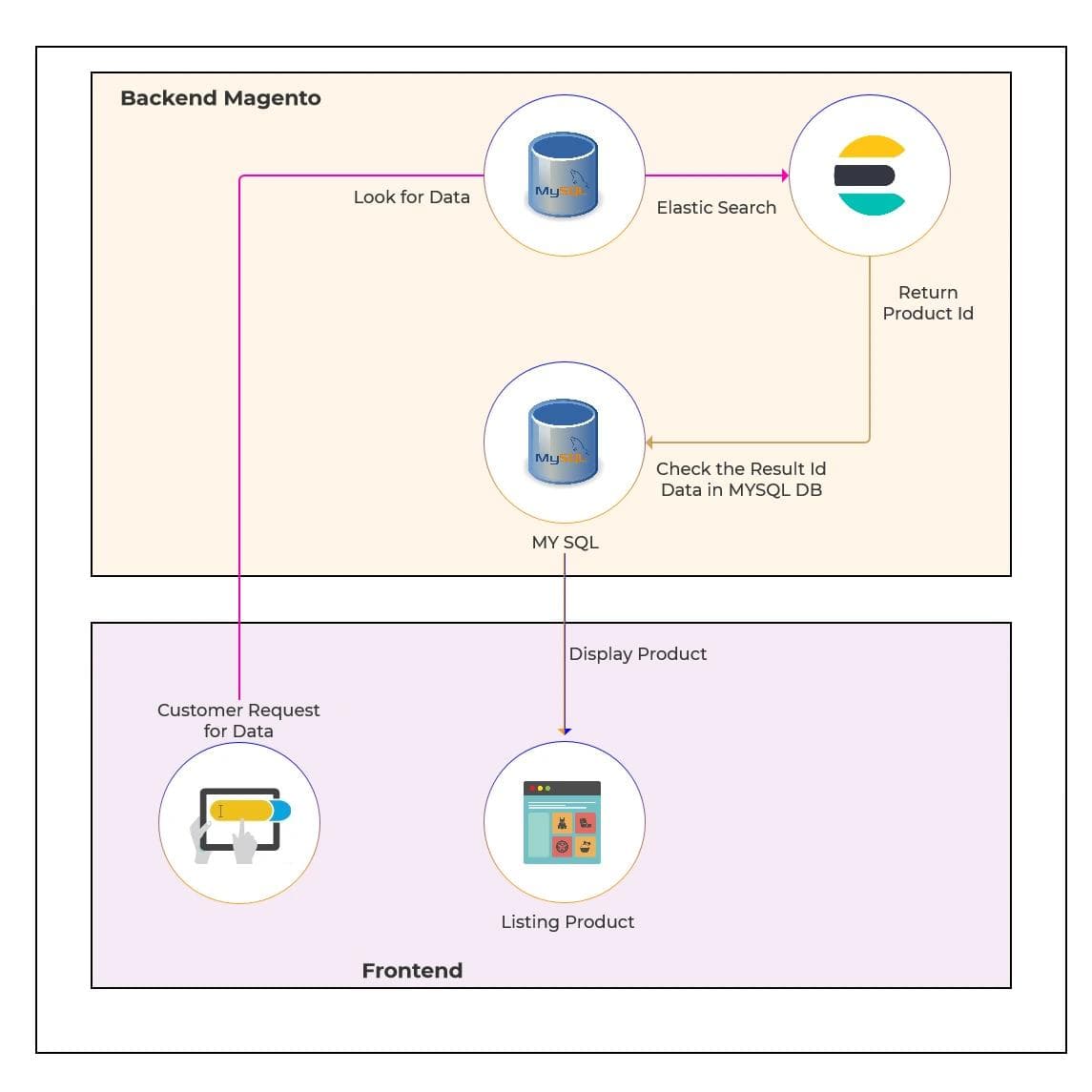
User Request ->Elasticsearch->Magento-> MySQL/MariaDB ->Magento->Listing Page
The issue arises due to multiple database calls. While many product details- such as names, prices, and images- are fetched in a single query, certain details, such as inventory or custom attributes, require separate database queries. These additional queries become resource-intensive especially for large catalogs or high-traffic stores. Conducting a Magento 2 code audit can help identify inefficiencies and streamline the database interactions for optimal performance. This process increases response times and delays the rendering of product listings leading to a substandard user experience.
PowerListing renders a streamlined flow by addressing technical limitations. Here’s how:
User request -> Elasticsearch -> Listing Page (No Database calls)
This is ideal for speed and scalability, especially with large catalogs.
User request -> Elasticsearch -> Cache Layer -> Listing Page
Both flows aim to minimize database calls and leverage Elasticsearch for faster product listing.
PowerListing significantly reduce page load times with optimized images, media and caching strategies ensuring that product listings load quickly even on resource intensive pages. Thus, leading to improved user experience and SEO.
Properly structured listings such as product titles, descriptions, tags etc. boost SEO rankings, making products easier to find on search engines and within the store.
Using PowerListing enables faster and more flexible filtering options, allowing users to find the products they are looking for, faster.
PowerListing's intuitive navigation and enhanced filtering make it easier for customers to browse and discover products. Surfacing relevant details like pricing, promotions, and customer reviews right on the listing page also becomes easier, which significantly influences purchase decisions.
The store can handle larger numbers of products and higher traffic volumes without a decline in performance.
PowerListing offers a streamlined approach to optimizing Magento 2 stores by addressing performance bottlenecks and enhancing the user experience. It isn't just a technical upgrade, it's an investment in your store's future. A faster, more responsive store translates to happier customers, better retention, and increased sales.
Ready to elevate your Magento store? Codilar's team can help you explore whether PowerListing is the right fit.
No. PowerListing shifts listing-related data retrieval to Elasticsearch, but MySQL still handles other parts of your Magento store, it's not a full database replacement.
The benefits scale with catalog size and traffic. Smaller stores may see modest gains; the impact becomes much more noticeable for large catalogs or high-traffic stores where database calls are the real bottleneck.
Not necessarily a full rebuild, but it does require properly indexing all critical product data (titles, prices, images, reviews) into Elasticsearch, which may need configuration work depending on your current setup.
Some, yes. A cache layer needs to be kept in sync with product updates, but the performance gains for high-traffic stores typically outweigh the added maintenance.
A Magento 2 code audit can help identify where the slowdowns are actually coming from, database calls, unoptimized queries, or something else, before committing to a specific fix like PowerListing.

Get tailored technology solutions to scale your retail business online
Request A Quote

Stay ahead with insights, trends, and brand success stories from the world of Digital Commerce.


DTECH, Techno Hub 1, Dubai Silicon Oasis Authority, United Arab Emirates - Dubai - United Arab Emirates

Level 1, Building 7, Zone A Airport road, Business Gate P.O Box 93597 Riyadh 11683, KSA.


Codilar Digital Pte Ltd, 68 Circular Road, #02-01, 049422, Singapore

7th Floor, Jupiter Block Prestige Tech Park, Kadubeesanahalli, Bellandur Amtankere, Bengaluru, Karnataka 560103

Satrio Tower, Floor 6, Unit C and D, Desa/Kelurahan Kuningan Timur, Kec. Setiabudi, Kota Adm. Jakarta Selatan, Provinsi DKI Jakarta