

How are Manufacturing Companies Growing Revenue Through eCommerce in 2026?


Listen Full Blog Here
Key Takeaways
- »eCommerce for manufacturers helps reduce costs, increase revenue, and expand into new markets.
- »A manufacturing eCommerce website enables 24/7 ordering, self-service, and faster procurement.
- »Manufacturer eCommerce meets modern B2B buyer expectations with real-time pricing and product information.
- »eCommerce for manufacturing delivers long-term growth through SEO, buyer data, and operational efficiency.
- »A successful manufacturing eCommerce website integrates ERP, PIM, and OMS for seamless B2B operations.
- »Delaying eCommerce adoption in manufacturing can result in lost customers, reduced visibility, and missed revenue opportunities.
How are Manufacturing Companies Growing Revenue Through eCommerce in 2026?
In 2019, 13% of B2B sales were generated digitally, and by the end of 2026, that figure is projected to reach 80%. The shift did not happen because manufacturers were told to go online. It happened because buyers stopped waiting for a sales call and started placing orders on their own terms, through portals, search engines, and supplier websites, at any hour, from any location.
Manufacturing companies that built a digital sales channel in the last 3 years did not simply open a website. They reduced the cost of serving existing accounts, started generating inbound inquiries from buyers who would never have reached a sales representative, and accessed markets that geography had previously made unreachable. The gap between manufacturers that moved early and those still evaluating the decision is measurable in revenue, account retention, and market share.
In this guide, explore how eCommerce for manufacturing actually delivers commercially, what industrial buyers are doing online right now, and what the data shows about the returns manufacturers are seeing.
Why are Manufacturing Companies Moving to eCommerce? The Revenue Shift That is Already Happening
The global B2B eCommerce market is projected to reach $36 trillion in 2026, growing at a 14.5% CAGR. Advanced manufacturing drives the largest share of that volume.
Manufacturer eCommerce is not about replacing existing sales relationships. It is about building a revenue channel that operates without the constraints of a sales team's time, geography, or working hours. This includes a self-service portal that handles reorders at 11 pm, a search-optimized product catalog captures a procurement manager researching in a new market, and a digital RFQ workflow that processes quote requests that previously sat in an inbox for days. The manufacturers seeing the strongest returns are those who treated the digital channel as a commercial investment rather than an IT project.
B2B eCommerce Website: What Does It Actually Generate for a Manufacturing Business?
The ROI question is the one most manufacturers ask before committing. In 2026, B2B eCommerce implementations deliver a 391% three-year return on investment with an average payback period of seven months, according to IDC's 2025 Business Value Study. Manufacturers who provide B2B buyers with easy-to-use digital interfaces see an average 30% increase in B2B sales, per McKinsey. The returns are not driven by technology alone, but come from four specific commercial outcomes a manufacturing eCommerce website generates that a sales-led operation structurally cannot.
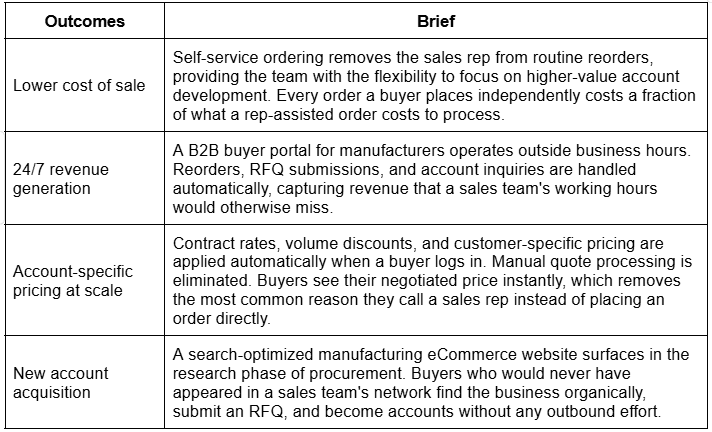
The operational gains compound the commercial ones. 67% of B2B buyers expect net payment terms that match their accounting cycles and 83% prefer self-serve online ordering. When a manufacturing B2B website delivers both, buyers stop calling and start ordering, which reduces the administrative burden on operations teams as much as it reduces the cost burden on the sales team.
Are Industrial Buyers Actually Purchasing Online? What Manufacturers Need to Know
Most manufacturers who hesitate on eCommerce share the same belief: their buyers are different. They prefer calls. They value relationships. They would not order a high-value component through a website. It is a reasonable belief. It is also, increasingly, wrong.
Today, a procurement manager evaluating two suppliers will check both websites before making contact. If one supplier has detailed product specifications, pricing indications, and stock availability online, and the other does not, the evaluation is often over before a sales call is made. 73% of B2B buyers say a supplier's website directly influences whether they choose to work with them.
A supplier's website is now as much a credibility signal as a sales channel. An outdated or thin website signals operational risk to a professional buyer, even when the manufacturer's actual capabilities are strong. What buyers are specifically looking for:
- Accurate product specifications and technical data that they can evaluate without calling
- Pricing logic or range indications that confirm the supplier is in the right bracket
- Stock availability or lead time information that helps them plan procurement
- Clear contact or RFQ options for when they are ready to proceed
The shift is not limited to routine reorders. High-value industrial purchases are increasingly completed digitally when the supplier's platform enables it. The assumption that complex sales cannot move online is being disproved by manufacturers who built the right digital infrastructure and found that buyers used it immediately.
eCommerce for Manufacturers: Building a Revenue Channel That Compounds Over Time
Most investments in a manufacturing business deliver a return once. A new machine increases output until it reaches capacity. A new hire covers more accounts until their pipeline is full. An eCommerce website works differently, and its value does not plateau.
Three effects build on one another simultaneously, and the longer the platform runs, the stronger each becomes:
SEO Authority Accumulates:
Product pages, category content, and technical guides indexed by search engines accumulate ranking authority every month. A page ranking on page two in month six reaches page one by month twelve. Unlike paid advertising, which stops generating leads the moment the budget stops, organic search traffic compounds continuously. Every new product page added to the catalog is a permanent, searchable asset that attracts buyers without recurring cost.
Buyer Data Sharpens Decisions:
Every transaction, abandoned cart, and search query on the platform generates data that a phone-and-email operation never captures. Over time, manufacturers use that data to improve product prioritisation, pricing strategy, inventory planning, and catalog structure. The platform becomes more commercially effective the more it is used, which means the return on investment improves without additional spend.
Cost per Order Falls:
As more buyers shift from calling to self-serving, the cost of processing each order drops. The sales team handles fewer routine reorders and focuses on higher-value account development. The efficiency gain grows as buyer adoption increases, meaning the same eCommerce investment generates more margin per order in year three than it did in year one.
From Catalog to Checkout: Features Every Manufacturing eCommerce Website Should Have
A manufacturing eCommerce website that does not match how industrial buyers actually purchase will not convert, regardless of how well it ranks or how much traffic it attracts. The features that make the difference are not cosmetic. They are the ones who remove friction from the procurement process at every step a buyer takes, from landing on the site to placing an order.
Below are the important features:
1. Advanced Search and Filtering
Industrial buyers searching thousands of SKUs need to find products by specification, material grade, tolerance, or certification. Faceted search and attribute-based filtering are the difference between a catalog buyers use and one they abandon.
2. Product Configurator
Let buyers with variable specification requirements build the exact product they need and receive accurate pricing before submitting. Removes the most common reason buyers call rather than order online.
3. ERP Integration for Real-Time Data
Live inventory levels, pricing, and lead times pulled directly from the ERP give buyers the information they need to plan procurement without calling. Eliminates orders placed against nonexistent stock.
4. PIM for Technical Product Data
Centralizes specifications, certifications, CAD files, and compliance documents so every product page carries the depth industrial buyers need to make a procurement decision independently.
5. Mobile-Optimized Buyer Portal
Procurement managers check stock, approve orders, and track shipments on mobile devices as often as on desktop devices. Mobile optimization is a baseline expectation for any buyer.
6. Approval and Workflow Management
Supports multi-step approval workflows for purchase orders requiring manager or finance sign-off, keeping the entire procurement process on the platform rather than in email chains.
Each feature delivers its full value only when connected to the back-office systems that hold the real data. The integration layer between the eCommerce platform and ERP, PIM, and OMS is where most manufacturing eCommerce implementations either succeed or fall short.
The Cost of Waiting: What Manufacturing Businesses Lose Every Quarter Without an eCommerce Channel
The decision to delay eCommerce rarely feels like a decision at all. There is always a more pressing capital allocation or a quarter where the timing does not feel right. The delay feels neutral, but it is not.
Every quarter, a manufacturing business operates without a digital sales channel, and four losses accumulate silently:
- Accounts lost to digitally mature competitors: A buyer who cannot find product specifications or pricing on a supplier's website finds a competitor who makes that information accessible. That loss never appears in a lost deal report because no conversation was ever started.
- SEO authority that cannot be recovered quickly: A competitor who launched two years ago has two years of indexed product pages and ranking history that cannot be replicated quickly. Starting later means paying more to reach the same buyers.
- Buyer data that is never captured: Every quarter without a digital channel is a quarter without data on what buyers search for, which products stall procurement, and which accounts are at risk.
- International markets that remain unreachable: A procurement manager in a market the sales team has never covered cannot find a manufacturer without a digital presence. The revenue opportunity exists but is structurally inaccessible.
The question is not whether eCommerce will eventually be necessary. It is whether starting now leaves enough runway to build the advantages that make it commercially significant.
Ready to build a manufacturing eCommerce website that generates revenue from day one?
Codilar works with manufacturing companies on Shopify Plus and Adobe Commerce (Magento) to build B2B eCommerce platforms structured for industrial buyers and built to scale. Start the conversation today.

FAQs
Most likely both, and that is the point. 61% of B2B buyers prefer a rep-free purchasing experience for routine orders. When a self-service portal is available, buyers use it for reorders and reserve calls for complex discussions. The sales team's time shifts to higher-value activity, not redundancy.
For mid-market manufacturers, the average payback period is 10 to 14 months with 30 to 40% self-service adoption in Year 1. Companies with high order volumes or labor-intensive processes often see faster payback because labor savings alone can cover the implementation cost within the first year. The biggest ROI driver is self-service adoption, not platform features.
Not if the platform is structured correctly. A well-built eCommerce setup separates B2B and D2C channels cleanly. Distributors access a portal with their account-specific pricing and contract terms. End consumers access a separate storefront. Many manufacturers find the digital channel handles routine reorders while distributors focus on relationship-led selling.
A straightforward B2B portal with ERP integration typically ranges from $50,000 to $150,000 for mid-market manufacturers. Complex implementations with custom configurators, multi-currency support, and deep ERP workflows sit higher. The integration layer covering ERP, PIM, and pricing systems is where most cost overruns occur and the least transparent cost in most proposals.
When a buyer logs in, they see only their negotiated price, the approved product list, and the contract terms, all automatically pulled from the ERP. Quotes that cannot be standardized route through a built-in RFQ workflow that keeps the transaction on the platform rather than moving it to email.

eRetail Growth
in Mind?
Get tailored technology solutions to scale your retail business online
Request A Quote


Subscribe to
Stay in Know
Stay ahead with insights, trends, and brand success stories from the world of Digital Commerce.