



General
BigCommerce to Shopify Migration: The Complete 2026 Guide
Meghna Vinod|Jun 29, 2026|Read 8 Min




SAP Hybris has been a cornerstone of enterprise eCommerce for over a decade, powering complex B2B and B2C operations for some of the world's largest brands. With mainstream maintenance for the on-premise version ending in July 2026, enterprises are now evaluating their migration options.
This guide explains what the deadline means in practice, how Shopify Plus compares as a destination platform, and what a migration from SAP Hybris to Shopify Plus involves at the enterprise level.
SAP Commerce 2205 is the final on-premise release of the platform commonly known as SAP Hybris. SAP has confirmed that mainstream maintenance for this version ends on July 31, 2026, a date specific to the on-premises deployment model. SAP Commerce Cloud, the vendor's hosted cloud product running on Microsoft Azure, continues to receive quarterly updates and is not affected by this deadline.
After July 31, 2026, SAP stops delivering security patches, bug fixes, legal change packages, certified JVM path updates, and new functionality for SAP Commerce on-premise. Enterprises can technically continue to run the platform, but they bear the full security and compliance risk themselves. A separate support arrangement, called Customer-Specific Maintenance, remains available but offers significantly reduced guarantees compared to standard maintenance.
SAP Commerce 2205 is the latest and final on-premise version of the platform commonly referred to as SAP Hybris. Released in 2022, it represents the last release SAP will deliver for the on-premise deployment model. SAP has been gradually transitioning away from the on-premise line since rebranding the product from SAP Hybris to SAP Commerce in 2018, with all subsequent innovation directed toward the cloud-hosted version, SAP Commerce Cloud.
The version history of SAP Commerce on-premise follows a structured release cadence. Each version carries a five-digit identifier corresponding to the year and month of release. Version 2205, released in May 2022, marks the endpoint of that cadence for on-premise deployments. No further on-premise versions are planned. Below is the update:
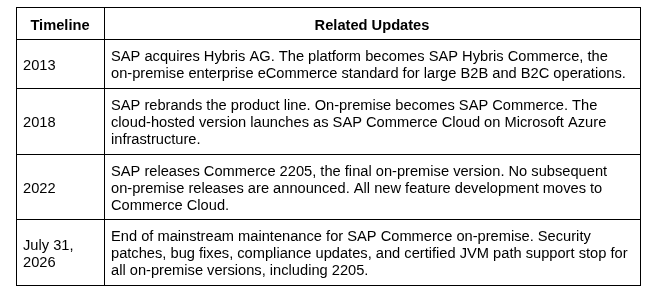
Enterprises running earlier on-premise versions, such as 1905 or 2011, are already past individual version support milestones. Version 2205 is the last supported on-premise release, meaning enterprises still on older versions have been operating without version-specific support for some time and face the same July 2026 platform-wide deadline regardless of which version they run.
The end of mainstream maintenance is forcing a platform decision that many enterprises have been deferring for years. Two paths dominate the conversation, either to stay within the SAP ecosystem by moving to SAP Commerce Cloud, or step outside it entirely by migrating to Shopify Plus. Both paths are viable. They serve different enterprise profiles, and understanding that difference is what makes the decision straightforward rather than contentious.
SAP Commerce Cloud is the natural successor for enterprises deeply embedded in SAP infrastructure. It retains native connectors to S/4HANA and ECC, which eliminates the middleware layer entirely. For businesses running complex multi-organization B2B hierarchies, contract-based pricing, and punchout catalog integrations with procurement systems like SAP Ariba, this continuity carries real commercial value.
Shopify Plus attracts a different kind of enterprise in 2026. It runs B2B and D2C from a single storefront, values implementation speed over configuration depth, and wants access to a 21,000-app ecosystem without depending on proprietary SAP development expertise. Shopify migrations complete in 16 to 28 weeks on average, which is significantly faster than a SAP Commerce Cloud deployment of comparable scope. The platform's total cost of ownership runs 23% lower on average.
Once an enterprise decides to move from SAP Hybris to Shopify Plus, the next question is, what does this actually involve? The answer depends heavily on what the Hybris environment looks like after years of operation.
Understanding the five workstreams and their timelines gives enterprise teams a realistic picture of the project before it begins. It also surfaces where complexity is concentrated, which is almost always in ERP integration and B2B pricing migration, not in the storefront build itself.
Data Migration and Catalog Restructuring (4 to 8 weeks)
Products, variants, customer hierarchies, order history, and B2B structures migrate from Hybris to Shopify Plus. Most Hybris extension libraries shrink 60 to 80 percent since Shopify Plus handles natively what they replicated.
SAP ERP Integration Rebuild (8 to 12 weeks parallel): Shopify Plus connects to S/4HANA and ECC through iPaaS middleware such as Boomi, MuleSoft, or Celigo. All data flows continue after migration. This workstream runs in parallel from week one and is the most common source of post-launch issues when scoped too late.
Shopify Plus Store Build and B2B Configuration (8 to 14 weeks): Covers theme development, Shopify Functions for checkout logic, B2B portal setup including company accounts, price lists, payment terms and draft orders, and Shopify Flow for automation. Hybris B2B pricing maps to Shopify B2B company profiles and shared catalogs.
SEO Migration and URL Redirect Mapping (2 to 4 weeks): Every active Hybris URL maps to its Shopify Plus equivalent through 301 redirects before go-live. Hreflang tags cover each market. The new sitemap submits to Google Search Console at launch with 90 days of post-launch monitoring.
Parallel Testing and Phased Cutover (3 to 6 weeks): Shopify Plus runs alongside the live Hybris store through UAT. Product counts, customer records, and order data reconcile before cutover. Most enterprise migrations phase the cutover by market with daily monitoring through the first two weeks.
SAP ERP integration is the most technically significant dependency for any SAP Hybris to Shopify Plus migration. Shopify Plus does not have native SAP connectors, but the integration does not disappear. It rebuilds through iPaaS middleware platforms that specialize in enterprise application connectivity. Boomi, MuleSoft, Celigo, and Workato all offer pre-built SAP to Shopify connectors tested in enterprise deployments. The storefront moves to Shopify Plus, the ERP stays on SAP, and the middleware manages all data flows that the native connector previously handled.
The following three integration patterns account for the majority of SAP to Shopify Plus deployments in 2026.
Real-time Event-driven Integration:
Order posting and inventory updates run as real-time flows, matching the performance of native SAP connectors for most enterprise transaction volumes.
Scheduled Batch Synchronization:
Product catalog updates, pricing changes, and customer master data sync on a scheduled basis. Most SAP Commerce Cloud implementations use this same approach in practice, regardless of the availability of native connectors.
Hybrid Model:
High-frequency transactional data flows in real time. Catalog and pricing data syncs on a schedule, reducing middleware load while maintaining data accuracy across both systems simultaneously.
A structured migration sequence is what separates enterprise replatforming projects that deliver on time and on budget from those that do not.
The seven steps below reflect the order and approach that produce the most predictable, lowest-risk migration for complex B2B and multi-site SAP Hybrid to Shopify Plus deployments.
After July 31, 2026, SAP Commerce on-premise stops receiving security patches, compliance updates, and bug fixes. The platform does not shut down on that date, but the cost and risk of staying on it rise steadily from that point forward. Customer-specific maintenance runs 2 to 4 times the standard fee, developer availability narrows as the on-premise ecosystem contracts, and every quarter of delay compounds both the technical debt and the eventual exit cost.
Enterprises that plan the migration as a structured program, rather than a forced response to the deadline, consistently deliver better outcomes across budget, timeline, and post-launch platform stability. Complex deployments run 16 to 28 weeks, which means the planning window is considerably shorter than most enterprise teams initially assume. Codilar Technologies brings over 240 specialists across Shopify Plus, Adobe Commerce (Magento), AEM, CRO, and performance hosting to help enterprise brands execute this migration with accuracy and confidence.
Evaluating your SAP Hybris migration options? Codilar's enterprise team will assess your current environment and build an execution plan aligned to your timeline. Connect today.
SAP Commerce on-premise ends mainstream maintenance on July 31, 2026. The platform does not shut down, but SAP stops delivering security patches, bug fixes, and compliance updates. Customer-specific maintenance remains available after the deadline but costs 2 to 4 times the standard fee. SAP Commerce 2205 is the final on-premise release.
Most migrations run 16 to 28 weeks for complex B2B and multi-site deployments. The ERP integration workstream runs 8 to 12 weeks in parallel with the main build and is consistently the longest workstream. Phased migrations rolling out market by market can extend beyond 28 weeks.
Shopify Plus natively handles moderate B2B complexity, including company accounts, customer-specific price lists, payment terms, and draft orders. Hybris B2B pricing maps to Shopify B2B company profiles and shared catalogs. Enterprises with deeply complex multi-organization hierarchies or punchout catalog requirements should evaluate Shopify Plus limits carefully before committing.
Yes, a well-planned migration strategy includes URL mapping, 301 redirects, metadata migration, sitemap updates, structured data validation, and post-launch SEO monitoring. These measures help preserve organic rankings, traffic, and search visibility after migration.
SAP Commerce Cloud licensing runs $150,000 to $500,000 or more per year. Shopify Plus starts at $2,300 per month. The ERP integration workstream adds $80,000 to $200,000 to the migration budget with middleware licensing adding $30,000 to $150,000 per year ongoing. Shopify Plus migrations deliver 23 percent lower TCO on average and pay back within 18 to 30 months.

Get tailored technology solutions to scale your retail business online
Request A Quote

Stay ahead with insights, trends, and brand success stories from the world of Digital Commerce.


DTECH, Techno Hub 1, Dubai Silicon Oasis Authority, United Arab Emirates - Dubai - United Arab Emirates

Level 1, Building 7, Zone A Airport road, Business Gate P.O Box 93597 Riyadh 11683, KSA.


Codilar Digital Pte Ltd, 68 Circular Road, #02-01, 049422, Singapore

7th Floor, Jupiter Block Prestige Tech Park, Kadubeesanahalli, Bellandur Amtankere, Bengaluru, Karnataka 560103

Satrio Tower, Floor 6, Unit C and D, Desa/Kelurahan Kuningan Timur, Kec. Setiabudi, Kota Adm. Jakarta Selatan, Provinsi DKI Jakarta