




Shopify
Shopify Canvas is Live: What It Can Handle and What It Cannot
Nikki Kumari|Oct 6, 2026|Read 8 Min




SEO for Shopify is evolving as AI becomes a larger part of how users discover products online. Google AI Overviews now generate summarized answers for many search queries, while AI assistants like ChatGPT are increasingly used to research products, compare options, and support purchase decisions. Thus, Shopify stores are no longer competing only for rankings in traditional search results but also for visibility within AI-generated responses.
For merchants, Shopify SEO optimization now extends beyond keywords and metadata. AI-powered search systems rely on structured data, detailed product information, technical website performance, topical authority, and credible trust signals to understand and recommend content. Stores that provide clear, accurate, and well-structured information are better positioned to appear across both conventional search results and AI-driven search experiences.
The guide examines how SEO on Shopify is changing in 2026, the factors influencing AI-powered product discovery, and the Shopify SEO best practices businesses can adopt to strengthen long-term organic visibility.
Search behaviour shifted faster in the last two years. Traditional Google search now accounts for 67% of product research, down from 89% in 2023. The gap went to ChatGPT, Perplexity, Microsoft Copilot, and Google AI Overviews.
Zero-click is now the default. When AI Overviews appear, organic clicks drop 38% and zero-click searches jump from 54% to 72%. For eCommerce specifically, only 3.2% of shopping queries trigger an AI Overview today. Transactional queries still drive clicks because shoppers need to visit a store to buy. That advantage narrows every quarter as AI systems build native checkout capabilities into their responses.
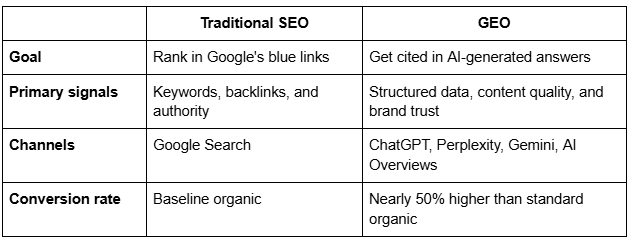
This is where Generative Engine Optimization, or GEO, comes in. GEO structures content, data, and brand authority so AI systems recommend a store's products in their generated answers. It does not replace traditional SEO. It builds on top of it.
Before any content or schema work delivers results, the technical foundation has to be solid.
Below are the three areas that consistently limit Shopify stores the most:
Most Shopify stores concentrate SEO effort on product pages and leave collection pages thin. That is the wrong priority order.
Stores that fix technical SEO before chasing keywords or backlinks see organic revenue grow two to three times faster.
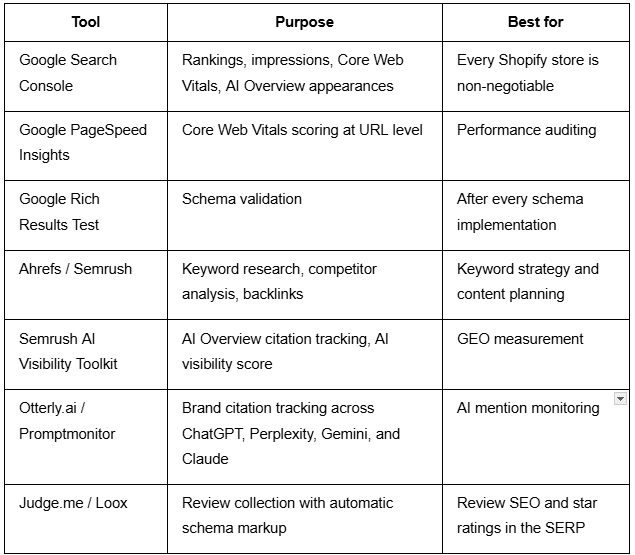
The right tools eliminate guesswork and surface issues that are invisible to manual auditing.
Schema has shifted from a nice-to-have SEO tactic to a load-bearing part of how Shopify stores get found. This is due to AI overviews showing on roughly 16% of eCommerce searches in 2026, and shopping agents like Perplexity and ChatGPT pulling answers directly from structured data.
Shopify's default themes include basic Product schema, but it is almost always incomplete.
Tier 1: Ship immediately
Tier 2: High impact for AI citation
Tier 3: Add for additional SERP features
Pages with complete Product schema are 2.5 times more likely to be cited in Google's AI Overviews, and stores with proper schema see 20-40% higher click-through rates compared to plain blue links. Star ratings from the Review schema increase clicks by 30% or more compared to listings without ratings.
Shopify's Summer '26 Everywhere Edition, shipped June 17, enabled Universal Commerce Protocol by default across all stores. Every eligible merchant's catalog is now discoverable inside ChatGPT, Perplexity, Microsoft Copilot, Google AI Mode, and Gemini without custom integration. But availability is not visibility. Whether AI agents recommend a store's products depends on data quality, content structure, and brand authority.
Here’s how to optimize specifically for AI search discovery:
1. Open AI crawler access
Confirm GPTBot, PerplexityBot, ClaudeBot, and Google-Extended are not blocked in robots.txt. Without this, nothing else matters.
2. Complete product data for every SKU
AI systems match products to buyer queries using product attributes. Every SKU needs a complete, specific description with use cases, dimensions, materials, and compatibility information. Vague descriptions do not get recommended.
3. Answer the questions buyers ask AI
The queries shoppers type into ChatGPT are conversational: "What is the best waterproof backpack for commuting under $100?" Product pages, collection pages, and buying guides optimized to answer these specific question formats are the ones AI systems cite in their responses.
4. Build external authority
E-E-A-T is evaluated by AI systems primarily through off-site validation: which authoritative publications mention or link to the brand, which trusted third-party platforms reference it, and what the broader web says about its credibility. Trustpilot reviews, editorial coverage, and industry citations are not optional for AI visibility. They are the trust layer AI systems use to validate whether a store is genuinely credible.
5. Measure AI visibility quarterly
Run 20 to 30 high-intent buyer queries across ChatGPT, Perplexity, Gemini, and Claude. Track whether the brand, products, or content appears in the responses. Use Semrush AI Visibility Toolkit or Otterly.ai to automate tracking at scale.
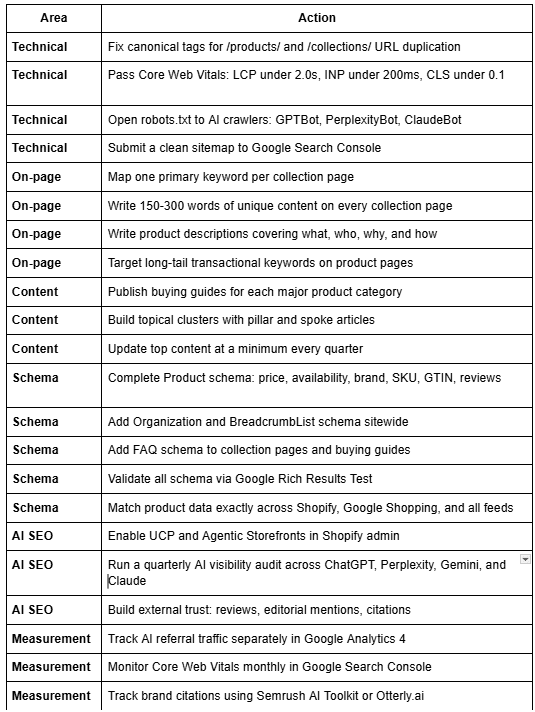
Shopify SEO in 2026 is a two-layer strategy. The technical and content foundation drives traditional search rankings. Structured data, complete product information, and external authority drive AI discoverability. Both layers share the same inputs and compound each other.
AI-attributed orders on Shopify grew nearly 13 times year over year between 2025 and 2026. The stores capturing that growth are not doing anything exotic. They are implementing a complete schema, writing product content that answers real buyer questions, maintaining data consistency, and measuring AI citation rates alongside traditional metrics.
Codilar Technologies works with Shopify Plus merchants on the technical SEO, structured data, and content strategies that build visibility across traditional search and AI-driven discovery channels. Start with a store audit and build from the foundation up.
To improve visibility in Google AI Overviews, create experience-driven content that directly answers customer questions, implement structured data, optimize product and collection pages, and strengthen internal linking. Comprehensive, authoritative content is more likely to be cited by AI-generated search results.
Yes. SEO now extends beyond Google rankings. Shopify merchants should optimize for AI-powered search experiences like Google AI Overviews and AI assistants by publishing trustworthy content, using structured data, and maintaining accurate product information.
The biggest trend is AI-driven product discovery. Search engines and AI assistants increasingly rely on structured product data, FAQs, schema markup, and detailed product attributes to recommend products, making high-quality product information more important than ever.
Focus on complete product data, descriptive collection pages, FAQ sections, Product and FAQ schema, and content that answers buyer questions. These elements help AI platforms better understand and recommend your products across multiple search experiences.
No, while keywords remain important, successful Shopify SEO now depends on topical authority, structured data, Core Web Vitals, EEAT signals, and content that satisfies both search engines and AI-generated search experiences.

Get tailored technology solutions to scale your retail business online
Request A Quote

Stay ahead with insights, trends, and brand success stories from the world of Digital Commerce.


