




Adobe
BigCommerce to Adobe Commerce (Magento) Migration for Scaling Brands
Aakash Ashok|Oct 16, 2026|Read 6 Min




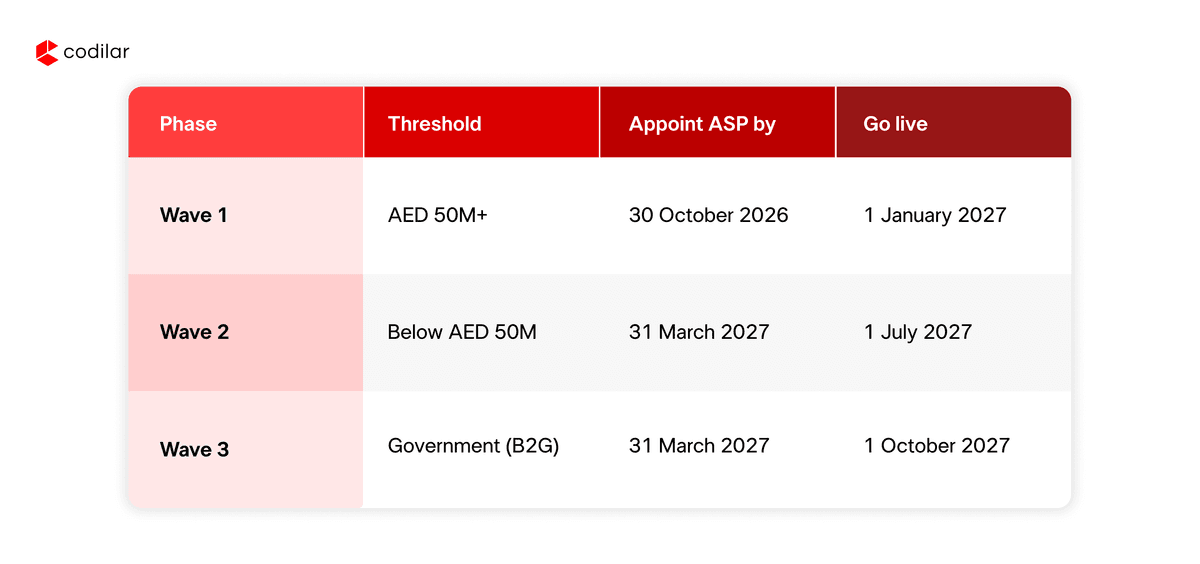
UAE e-invoicing becomes mandatory on 1 January 2027 for businesses turning over AED 50 million or more. To hit that date, you must appoint an Accredited Service Provider by 30 October 2026, about ten weeks from now.
Every guide published on this so far has been written for finance teams. But if you run B2B trade through Adobe Commerce (Magento) or Shopify, the work doesn't happen in finance. It happens in your order-to-invoice flow, your ERP integration, and customer records that were never built to hold a Tax Registration Number.
Under the Ministry of Finance's Electronic Invoicing System, an in-scope invoice must be issued as UBL 2.1 XML in the PINT AE format, transmitted through a Ministry-accredited service provider, and reported to the Federal Tax Authority.
A PDF no longer qualifies. Neither does a scanned copy or the invoice your storefront currently emails after checkout.
The UAE uses a Peppol-based five-corner model: you send to your ASP, your ASP validates and routes to the buyer's ASP, and the tax data reaches the FTA in near real time. You never connect to the FTA directly. That single fact shapes your whole architecture…your platform's job isn't to talk to the tax authority, it's to hand your ASP a complete, correct payload.
Who's in scope: B2B and B2G transactions, regardless of VAT registration status. Free zone entities included. B2C is currently excluded, but most GCC retailers run wholesale or corporate accounts on the same instance as their consumer storefront, and those orders are in scope even if they're a small share of volume. If you've built trade accounts into your storefront, this applies to you.
The Deadline Problem Nobody Is Discussing
Read those dates together and it looks like five months of runway. It isn't. It's nine weeks, and they're the worst nine weeks of the retail year.
Appointing an ASP is a procurement decision. Integrating with one is an engineering project: data mapping, field validation, error handling, end-to-end testing against a live tax authority. If 30 October is when you start, your build and UAT land on top of White Friday, December gifting, and year-end close. No sensible team deploys an invoice-flow change into production during peak trading.
The real deadline for choosing an ASP is now, so the build happens inside the voluntary pilot window running to December 2026, where errors surface without penalty exposure. Penalties apply once you're formally mandated, not during voluntary participation.
That's the strongest argument for moving this quarter instead of next.
Neither Magento Open Source nor Adobe Commerce supports PINT AE out of the box. Bringing the platform into compliance requires changes across invoice events, customer attributes, integrations, and the checkout flow. In practice, that means more than a tax configuration. It requires Adobe Commerce development across the parts of the platform that create, validate, and transmit invoice data.
Your Magento invoice isn't a tax invoice. It's a fulfilment artifact. It doesn't carry the field set the FTA's Data Dictionary requires, and its creation event was never designed to trigger a regulatory transmission. A synchronous observer on invoice saves couples order processing to a third-party API, meaning an ASP outage becomes an order outage. Transmission needs to be asynchronous, with retry, idempotency keys so retries don't duplicate submissions, and the ASP acknowledgement stored against the invoice.
Your customer data won't survive validation. Adobe Commerce B2B company accounts have no native TRN attribute. Your buyer's Peppol identifier, which combines the 0235: UAE identifier with their 10 digit TIN, almost certainly isn't captured anywhere today. You'll need new validated attributes, front-end input masking at corporate registration, legal entity names exactly as registered rather than as typed at checkout, and a full cleanse of existing B2B records.
Credit memos become electronic credit notes. Every refund on an in-scope order needs a compliant credit note referencing the original invoice. Partial refunds create several per order, each needing its own preceding-invoice reference. Late or missing ones cost AED 100 per document.
Multi-country setups need two integrations, not one. A single instance serving UAE and Saudi store views is now under two regimes: the FTA's Peppol model here, ZATCA's Fatoora clearance model there, where Wave 25 dropped the threshold to SAR 187,500 with a 1 February 2027 deadline. Different mechanisms, different code paths. For brands selling across several GCC markets from one stack, this is an architecture decision, not a plugin choice.
Direct extension: Your platform calls the ASP API itself. Fastest to deliver, least flexible when tax rules change or a second country is added. Suits simple setups with no heavy back office.
ERP as system of record: Commerce captures the order, the ERP owns invoicing and transmission. Right for most enterprises. The risk sits in the sync layer: if your order-to-ERP integration flattens attributes, the ERP produces a structurally valid invoice carrying the wrong data.
Middleware: A layer between commerce and ASP handles mapping and routing. On Adobe Commerce, App Builder and API Mesh are built for exactly this, and it keeps compliance logic outside your core codebase so it survives upgrades. That matters more than it looks if you're also heading toward the cloud-native direction Adobe is steering merchants into, where core modification stops being an option. This approach is particularly useful when your Adobe Commerce store needs to exchange data with multiple systems, including ERP, PIM, payment, and compliance platforms.
Which of the three is right depends on where your invoice is genuinely created today, which isn't always where merchants assume. That is worth establishing before you sign an ASP contract because it determines where the compliance logic, data mapping, and failure handling should actually live.
AED 5,000 per month for failing to appoint an ASP or implement on time. AED 100 per invoice or credit note transmitted late, capped at AED 5,000 monthly. AED 1,000 per day for failing to notify the Authority of a system failure within two business days, which means monitoring and alerting are a regulatory requirement, not a nice-to-have.
The fines are recoverable. The commercial damage isn't. Invoices issued outside the system aren't verifiable by the FTA, which puts your buyers' input VAT claims at risk. For a B2B business, customers unable to reclaim VAT on your invoices is a far bigger problem than the penalty itself.
Ask your team six questions:
If you can't answer most of them confidently, you need a technical assessment before you sign an ASP contract, not after. Choosing a provider without knowing which of the three architectures you're building is how merchants end up paying twice.
There are two kinds of firm selling help with this, and neither covers the whole problem.
Tax consultancies and ASPs understand the FTA rules precisely, but they can't tell you where in Adobe Commerce the invoice event fires, why your B2B company entity is missing a TRN field, or what happens to your credit note flow when a customer takes a partial refund. They'll hand you a specification and expect someone else to build it.
Magento agencies can build it, but most have never worked inside a GCC tax regime. They'll discover the free zone edge cases, the AED conversion rules, and the two-business-day failure notification requirement during UAT, on your timeline.
Codilar sits in the narrow overlap. We've built and run enterprise commerce across the UAE, Saudi Arabia, and Oman for more than a decade, with teams on the ground in Dubai, Riyadh, and Muscat, and Adobe Gold Partner status behind the platform work. The same people who understand your ERP sync also understand what the FTA expects to receive from it, and stay with the build after go-live, which matters when the penalty for an unreported outage is daily.
Ten weeks is enough time to do this properly. It isn't enough to do it twice.
For in-scope B2B and B2G transactions, yes. Businesses at AED 50 million or above must appoint an ASP by 30 October 2026 and go live by 1 January 2027; smaller businesses appoint by 31 March 2027 and go live by 1 July 2027. Purely B2C transactions are currently excluded.
Adobe Commerce and Magento do not natively generate UAE compliant PINT AE invoices or transmit them through an Accredited Service Provider. Businesses will need to connect their commerce platform with an ASP directly or through an ERP or middleware integration.
UAE e-invoicing can be integrated with Adobe Commerce through a direct ASP integration, an ERP led invoicing architecture, or middleware. The right approach depends on where invoices are generated, how your ERP and commerce systems exchange data, and how much of the invoicing process needs to remain outside the commerce platform.
Your Adobe Commerce setup needs to capture and validate key buyer and transaction data required for a compliant electronic invoice. This includes the buyer's Tax Registration Number, Peppol identifier, legal entity details, tax information, invoice details, and references required for credit notes and adjustments.
Yes. In scope B2B transactions must follow UAE e-invoicing requirements. This applies even when B2B orders represent only part of a Magento or Adobe Commerce store's sales. Businesses operating B2C and B2B transactions from the same platform need to identify which transactions fall within the mandate.

Get tailored technology solutions to scale your retail business online
Request A Quote

Stay ahead with insights, trends, and brand success stories from the world of Digital Commerce.


