




Adobe
BigCommerce to Adobe Commerce (Magento) Migration for Scaling Brands
Aakash Ashok|Oct 16, 2026|Read 6 Min



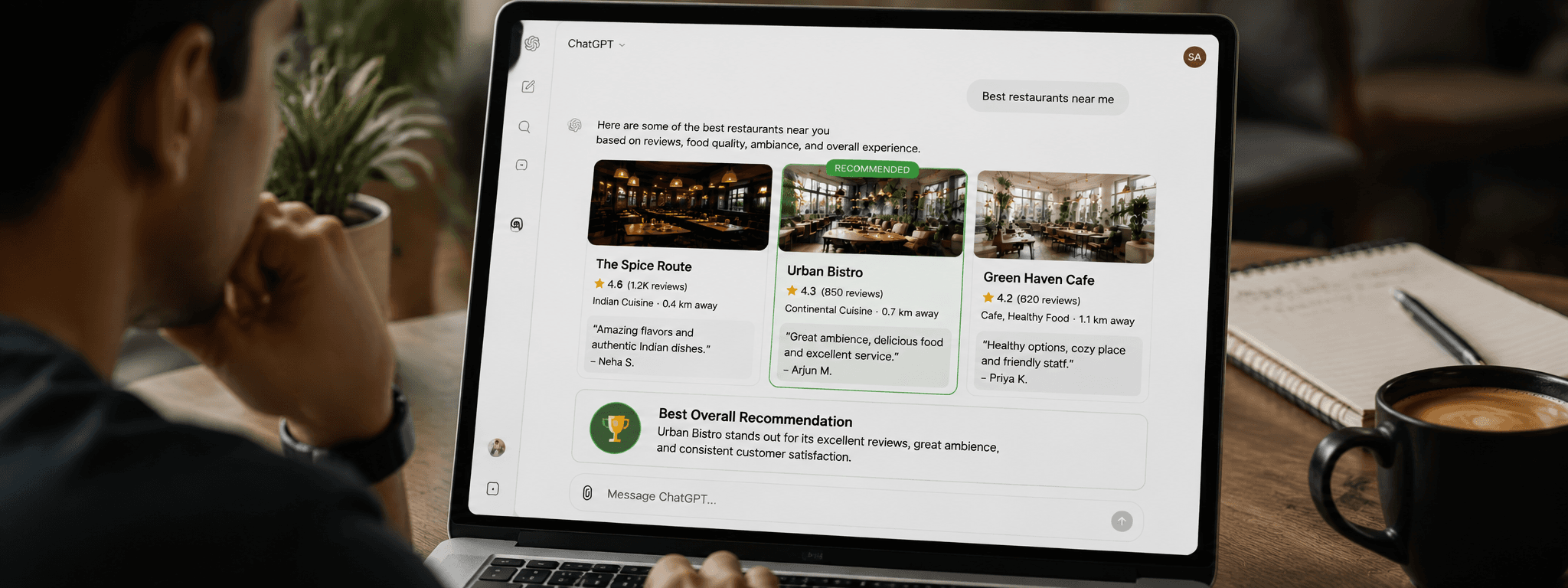
Let's start with something you can do in the next ten seconds. Open ChatGPT and ask it to recommend a product in your category, at whatever price point your customers usually shop. Go on, actually try it.
If your Adobe Commerce or Magento store didn't come up, don't worry, you're in good company. Plenty of merchants with fast, well-built, SEO-solid stores are getting the same result. It's not because their SEO is broken. It's because SEO was built to answer a completely different question than the one AI shopping agents are now asking.
For years, the rule was simple: rank well on Google, get found, get the sale. That rule still applies. But there's a second, newer layer sitting on top of it now, one that decides whether an AI assistant even considers recommending you in the first place. And right now, across 170,000-plus stores running on Adobe Commerce and Magento Open Source, most of them are failing it without knowing it.
The reason is straightforward once you see it: most Adobe Commerce stores were built for Google discovery, not AI discovery. AI does not browse a results page and click. It reads, decides, and recommends, often without the shopper ever landing on your site. This guide is a practical GEO/AEO audit for Adobe Commerce and Magento merchants, covering what AI shopping agents actually look for, the new agentic commerce protocols shaping 2026, and what to fix first.
SEO and Adobe Commerce SEO best practices (site speed, schema, backlinks, keyword-optimized content) still matter. They are the foundation. But Generative Engine Optimization (GEO) and Answer Engine Optimization (AEO) are a distinct, additional layer, because AI systems do not rank pages the way Google's classic algorithm does. They synthesize an answer from whatever data they can reliably read, verify, and trust, then present one recommendation or a short list, not ten blue links.
That distinction matters more than it sounds. A store can rank on page one of Google and still be functionally invisible to ChatGPT, Perplexity, or Google's AI Overviews, because those systems are evaluating a completely different set of signals: whether your product data is structured cleanly, whether your content answers a decision rather than a keyword, and whether AI crawlers can even access your pages in the first place.
Beyond being found, there is a second and newer question: can an AI agent actually buy from your store on a shopper's behalf? This is called agentic commerce, and in 2026 it runs on a small set of competing open standards.
Agentic Commerce Protocol (ACP), built by OpenAI and Stripe, powers ChatGPT's Instant Checkout. It defines a structured product feed, a five-endpoint checkout API, and a delegated payment token so an agent can complete a purchase without ever holding raw card details.
Universal Commerce Protocol (UCP), announced by Google, is built to connect merchant catalogs to Google Search's AI Mode and Gemini.
Model Context Protocol (MCP), created by Anthropic, is the standard Adobe adopted for its own Adobe Commerce MCP server, letting AI agents query catalog, pricing, inventory, and checkout data directly.
None of these has "won" yet, and the ground will keep shifting through 2026. For most Adobe Commerce and Magento merchants today, the practical takeaway is not to bet everything on one protocol. It is to get the underlying product data and feeds clean enough that your store can plug into whichever standard ends up mattering most for your customer base.
Across dozens of independent Adobe Commerce and Magento audits, the same pattern shows up again and again: most stores fail on at least three of these five layers.
1. Product data structure. Inconsistent attributes, messy variant naming, and incomplete schema markup mean an AI system simply cannot parse your catalog reliably, even if a human shopper could.
2. Content layer. Pages built around keywords rather than decisions (no "best for X," no comparisons, no clear use-case framing) get skipped, because AI systems are trying to answer a question, not match a search term.
3. Trust signals. Weak cross-platform credibility, inconsistent reviews, and low domain authority get filtered out. AI systems weigh trust signals heavily before citing or recommending a source.
4. Crawlability and feeds. Heavy JavaScript rendering, missing or outdated sitemaps, and no API-first access mean AI crawlers cannot retrieve your data at all, regardless of how good the content is underneath.
5. Security and maintenance. Unpatched systems and unstable data layers are a trust risk for both human shoppers and the AI systems that might otherwise recommend you.
The technical version of this audit gets specific fast. AI crawlers like GPTBot, ClaudeBot, and Google-Extended need explicit allowances in robots.txt. A growing standard called llms.txt gives AI systems a clean content map of your site. Product pages need complete JSON-LD schema (name, price, offers.availability), not partial markup. And stores that want to appear in ChatGPT Shopping need a properly formatted AI product feed, separate from a standard Google Shopping feed.
Most merchants think GEO is a content problem. It's actually a data problem wearing a content costume. Fix the product data and the feeds first, and the content work becomes ten times easier."❞

Mahaveer Devabalan | Co-founder & Head of eCommerce Solutions, Codilar
Adobe itself has moved on this. At Adobe Summit in 2026, Adobe introduced its own Adobe Commerce MCP server, built on Anthropic's Model Context Protocol, letting AI agents query catalog, cart, pricing, inventory, and checkout data directly from an Adobe Commerce instance. The honest caveat: the fully agentic capabilities require an Adobe Experience Platform license, which puts this squarely in enterprise territory rather than a free, out-of-the-box feature.
More recently, Adobe announced Adobe Brand Visibility, a joint solution combining Semrush's AI-visibility intelligence with Adobe's content optimization tools. It draws on a large database of real-world AI search prompts to show brands how often they are mentioned across ChatGPT, Google AI Mode, Microsoft Copilot, and Perplexity, alongside competitive share-of-voice data. Adobe has reported that AI-driven traffic to U.S. retail sites grew well over 1,000% between late 2024 and mid-2026, which gives a sense of how quickly this channel has moved from experimental to material.
AI Overviews and similar AI-generated answer boxes sit slightly upstream of full agentic checkout, but they run on the same underlying signals. If your product schema, FAQPage markup, and content structure are not clean enough for an AI Overview to cite you, they almost certainly are not clean enough for a shopping agent to recommend you either. Treating AI Overview visibility and full agentic-commerce readiness as two separate projects usually means duplicating work that could be done once, at the data and feed layer.
Merchants who get ahead of this are rarely doing full redesigns. It is quieter, more structural work: cleaning and standardizing the catalog, rebuilding content around decisions, fixing structured data so it is actually meaningful, and treating the Adobe Commerce backend as a data engine rather than just a storefront.
This is fundamentally a backend and data-architecture problem before it is a content problem, which is where Codilar's Adobe Commerce experts have always focused their work: catalog structure, performance, and platform stability at scale. This same GEO shift is already showing up across other verticals, including how food and beverage brands are building structured product data for AI-driven discovery, a pattern Codilar has covered in detail elsewhere. It's consistent across every category: clean, structured product data is what AI systems need to recommend you, whether the one asking is a human shopper or a machine.
Is your Adobe Commerce store actually AI-readable, or just human-readable? Those are no longer the same question, and the gap between them is already costing visibility for stores that assume good SEO is enough.
Want a clear picture of where your store stands? Get in touch with Codilar's Adobe Commerce team for a GEO/AEO readiness conversation before your competitors close the gap.
The stores getting cited by ChatGPT, recommended by Gemini, or transacted with directly through an AI agent are not necessarily the best-ranked stores. They are the best-understood by AI. For Adobe Commerce and Magento merchants, that shift rewards exactly the kind of structural discipline the platform has always demanded: clean data, stable architecture, and content built around real decisions rather than keywords. The merchants treating this as infrastructure work, not a marketing afterthought, are the ones who will still be visible when agentic commerce stops being early and starts being standard.
SEO ranks your pages in a search engine's link list. GEO (Generative Engine Optimization) is about being cited or recommended inside an AI-generated answer, whether that's ChatGPT, Perplexity, or Google AI Overviews. Both rely on good fundamentals, but GEO adds requirements like structured data, llms.txt, and AI-readable product feeds that classic SEO never needed.
Check your robots.txt file for explicit rules covering GPTBot, ClaudeBot, OAI-SearchBot, PerplexityBot, and Google-Extended. Many default Magento and Adobe Commerce configurations either block these bots or simply never mention them, which some AI crawlers treat as a signal to skip the site entirely.
The Adobe Commerce MCP server uses the Model Context Protocol to let AI agents query catalog, cart, pricing, and checkout data directly. Yes, the fully agentic capabilities currently require an Adobe Experience Platform license, which makes this an enterprise-tier feature rather than something available out of the box on every Adobe Commerce instance.
ACP (Agentic Commerce Protocol) is built by OpenAI and Stripe and powers ChatGPT Instant Checkout. UCP (Universal Commerce Protocol) is Google's standard for its AI Mode and Gemini. MCP (Model Context Protocol) was created by Anthropic and is the standard Adobe adopted for its own Commerce MCP server. None has become the single industry standard yet, so most merchants are best served by clean, portable product data rather than betting on one protocol exclusively.
Start with the data layer, not the content layer. Complete and consistent product schema, an accurate AI-readable product feed, and correct robots.txt rules for AI crawlers typically produce a bigger visibility improvement, faster, than rewriting existing content. Content built around decisions and comparisons matters too, but it performs far better once the underlying data is clean.

Get tailored technology solutions to scale your retail business online
Request A Quote

Stay ahead with insights, trends, and brand success stories from the world of Digital Commerce.


