



General
eCommerce Website Development for Grocery Brands in the UAE
Aakash Ashok|Sep 11, 2026|Read 6 Min



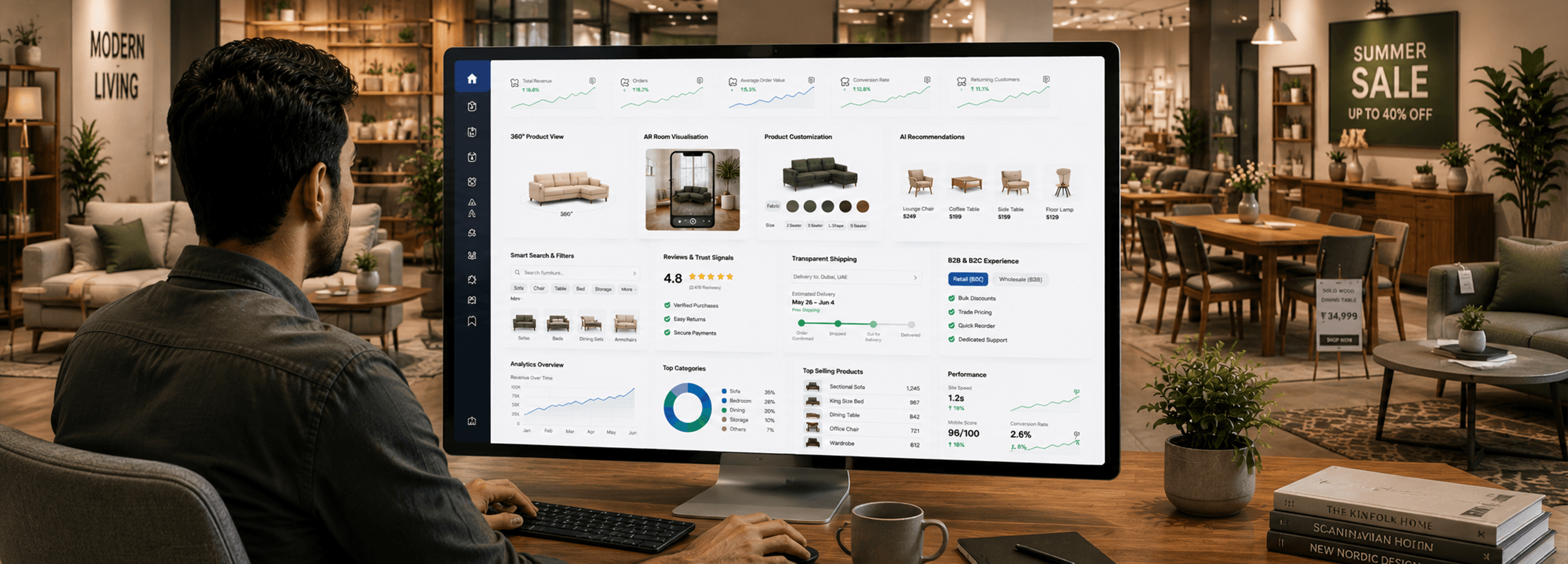
Furniture is one of the strangest categories to sell online, and also one of the most rewarding to get right. Customers are spending hundreds or thousands of dollars on something they cannot touch, sit on, or measure against their own living room before they buy. That single fact shapes almost everything about what a good furniture eCommerce website actually needs, and it is why so many furniture brands that copy a generic eCommerce playbook end up with high traffic, high cart abandonment, and low conversion.
This guide walks through everything that actually matters if you are doing furniture website development, including the features that reduce returns and build trust, how to choose between the platforms competing to be the best websites to sell furniture, what to realistically budget, and how established furniture retailers are actually doing this today.
Furniture eCommerce has moved well past the early days of low-resolution photos and vague dimensions. Industry estimates consistently place the global furniture eCommerce market in the hundreds of billions of dollars, with steady year-over-year growth, and mobile now accounts for the majority of browsing traffic in many regions. Shoppers are researching heavily online (comparing materials, dimensions, and reviews across multiple tabs) even when a meaningful share still complete the purchase on desktop or over the phone.
A few shifts define where the category is headed. Sustainability and circular commerce (resale, refurbished, and transparent sourcing) are becoming genuine purchase factors, not just marketing language. Conversational commerce, where a shopper gets recommendations or answers through a chatbot or messaging interface, is moving from novelty to expectation. And average order values in furniture, often between several hundred and several thousand dollars per item, mean that trust signals and visualization tools matter more here than in almost any other retail category.
A handful of factors make furniture fundamentally different from a typical eCommerce build:
Every feature and platform decision covered in this guide exists to solve one or more of these five problems.
If there is one lesson from every furniture retailer that has succeeded online, it is this: invest in visualization before you invest in almost anything else.
360-degree product views let shoppers rotate a piece and inspect it the way they would in a showroom, and high-quality, high-resolution imagery paired with 360-degree views has become close to a baseline expectation rather than a differentiator. Augmented reality (AR) room visualization takes this further, letting customers place a piece of furniture in their actual room using a smartphone camera to check scale, color, and fit before buying. This single feature has a well-documented effect on reducing returns, since a meaningful share of furniture returns stem from a customer misjudging size or how a color would actually look in their space.
Furniture customization tools, such as configurators that let a shopper choose fabric, frame color, and dimensions and see an updated visual and price in real time, are especially valuable for higher-end and made-to-order furniture. Beyond visualization, a few other features consistently show up in every serious furniture eCommerce build: detailed specifications and assembly information on every product page, transparent shipping costs shown early rather than buried at checkout, and visible trust signals like photo reviews, satisfaction guarantees, and clear return policies, since these matter disproportionately when a customer is about to spend a few thousand dollars on something sight unseen.
AI-powered product recommendations have become a meaningful lever in furniture eCommerce specifically because furniture shopping is rarely a single-item decision. A customer buying a sofa is very likely also shopping for a coffee table, a rug, and accent pieces that match a certain style, and AI-driven merchandising engines can surface complementary products based on browsing behavior, style preferences, and past purchases far more effectively than static "related products" blocks ever could.
This extends beyond recommendations into personalized search and filtering, smart chatbots that can answer specification questions instantly, and increasingly, personalized pricing or delivery timing based on a customer's location and order history. For furniture retailers running both B2C and B2B channels from the same platform, AI-driven personalization can also differentiate the experience automatically, showing retail pricing and imagery to one visitor and wholesale terms and bulk-order tools to another, without maintaining two separate storefronts.
"Furniture is one of the few categories where AI personalization pays for itself almost immediately. When a shopper who bought a dining table gets shown the matching chairs instead of a generic recommendation, that is a completed room, not just a completed sale."❞

Mahaveer Devabalan | Co-founder & Head of eCommerce Solutions, Codilar
15+ Years of Experience
There is no single best platform among the many websites to sell furniture run on today. The right choice depends on catalog size, whether you serve B2B and B2C together, and how much customization your buying journey requires.
Shopify works well for D2C furniture brands of most sizes, with strong shipping and freight app integrations, phone-sales-friendly design, and a large ecosystem of review and trust-badge apps that matter heavily for high-ticket purchases.
Adobe Commerce (Magento) is built for enterprise furniture retailers running complex B2B and B2C operations together, multiple regions or currencies, and deeply customized buying journeys, the kind of complexity that shows up once a retailer is operating at genuine scale rather than a single-region storefront.
For large-catalog, multi-region, or B2B-plus-B2C operations specifically, Codilar's Adobe Commerce experts and omnichannel commerce work focus on exactly this kind of complexity, building platforms that hold up under large SKU counts and real-time inventory demands rather than just looking good in a demo.
As with most eCommerce categories, there is no single honest number here, and any guide claiming otherwise is oversimplifying. What's more useful is understanding the tiers.
Starter tier suits new or small furniture brands with a modest catalog, typically a premium theme with light customization, standard checkout, and basic product photography, enough to launch and validate demand without the full visualization suite.
Growth tier is where most established furniture D2C brands land, with custom storefront design, freight and shipping integrations, review and trust-badge tools, and often a first visualization feature like 360-degree product views or a basic configurator.
Enterprise tier is built for large catalogs, multi-region operations, or brands running B2B and B2C side by side, and almost always requires deeper backend work: full AR and configurator suites, AI-driven search and recommendations, ERP integration, and platforms like Adobe Commerce that can handle tens of thousands of SKUs across multiple markets and currencies.
Beyond the initial build, ongoing costs worth budgeting for include maintenance and support, freight and shipping software subscriptions, professional photography and 3D asset creation (which is more involved for furniture than almost any other category), and payment processing for higher-value transactions, some of which may include buy-now-pay-later options that themselves carry a percentage fee.
The theory in this guide plays out clearly across real furniture retailers Codilar has worked with, including Homes r Us, Marina Home, and Danube Home.
Homes r Us, the GCC's home-grown furniture and decor brand with 26 stores across four markets, was managing a catalog of over 25,000 products where category and filter pages were taking three to five seconds to load, a delay that was quietly suppressing purchase intent before a single product was even properly considered. Codilar's Adobe Commerce experts restructured how listing data was indexed, cutting filter page load time by 75 percent and overall product listing page load time by 55 percent, while also launching native bilingual Android and iOS apps and connecting the platform to their ERP for real-time pricing and stock accuracy.
Marina Home, a premium home fashion brand across the GCC, North Africa, and the Sub-Continent, hit an infrastructure ceiling as traffic grew: slow performance during peak periods, fragile deployments, and no ability to scale automatically. Rebuilding the architecture on a scalable, auto-scaling AWS foundation delivered a 35 to 45 percent improvement in page load speed and two to three times higher traffic capacity without performance degradation, proving that furniture eCommerce performance is as much an infrastructure problem as a design one.
Danube Home, a leading Middle East furniture and home decor retailer, needed to launch across 35 countries on a single Adobe Commerce instance with over 100,000 SKUs, full RTL Arabic support alongside English, and real-time AI-powered personalization for a category where customers explore many options before buying. The resulting headless Adobe Commerce Cloud build, with AI-driven search and recommendations, multi-currency support, and click-and-collect, delivered a threefold boost in site speed and measurably higher mobile conversions.
Building a furniture eCommerce website that actually converts is less about finding the flashiest platform and more about solving a specific, well-understood problem: giving a customer enough confidence to spend real money on something they cannot touch. Visualization, customization, AI-driven personalization, and a platform that can handle your catalog's real complexity all exist to solve that one problem. Get that right, and the rest of the eCommerce playbook works the way it's supposed to.
Thinking through your own furniture eCommerce build? Get in touch with Codilar's furniture eCommerce development experts to talk through what your catalog and customer journey actually need.
Yes, for most direct-to-consumer furniture brands. Shopify offers strong freight and shipping app integrations, a large ecosystem of trust-badge and review apps that matter for high-ticket purchases, and an easy setup for phone-sales-friendly design. Larger or B2B-heavy catalogs may eventually need Adobe Commerce instead.
It depends heavily on catalog size and feature depth. A starter store with basic photography and a premium theme costs far less than an enterprise build with AR visualization, AI-driven personalization, and multi-region support. Budgeting for ongoing costs like photography, shipping software, and maintenance matters as much as the initial build cost.
360-degree product views, AR room visualization, and detailed specifications with accurate dimensions are the biggest levers, since a large share of furniture returns come from customers misjudging size, color, or fit. Furniture customization tools with live previews also reduce the mismatch between what a customer expects and what they receive.
There isn't one universal answer. Shopify suits most D2C furniture brands, and Adobe Commerce suits enterprise retailers running large, multi-region, or combined B2B and B2C operations.
AI-powered product recommendations help customers complete a room, not just a single purchase, by surfacing complementary items based on browsing and purchase behavior. AI also powers smarter search and filtering across large catalogs, and can personalize pricing or content differently for retail versus wholesale visitors on the same platform.

Get tailored technology solutions to scale your retail business online
Request A Quote

Stay ahead with insights, trends, and brand success stories from the world of Digital Commerce.


DTECH, Techno Hub 1, Dubai Silicon Oasis Authority, United Arab Emirates - Dubai - United Arab Emirates

Level 1, Building 7, Zone A Airport road, Business Gate P.O Box 93597 Riyadh 11683, KSA.


Codilar Digital Pte Ltd, 68 Circular Road, #02-01, 049422, Singapore

7th Floor, Jupiter Block Prestige Tech Park, Kadubeesanahalli, Bellandur Amtankere, Bengaluru, Karnataka 560103

Satrio Tower, Floor 6, Unit C and D, Desa/Kelurahan Kuningan Timur, Kec. Setiabudi, Kota Adm. Jakarta Selatan, Provinsi DKI Jakarta