



General
BFCM 2026: Reduce Cloud Infrastructure Costs Before Peak Season
Nikki Kumari|Sep 10, 2026|Read 6 Min



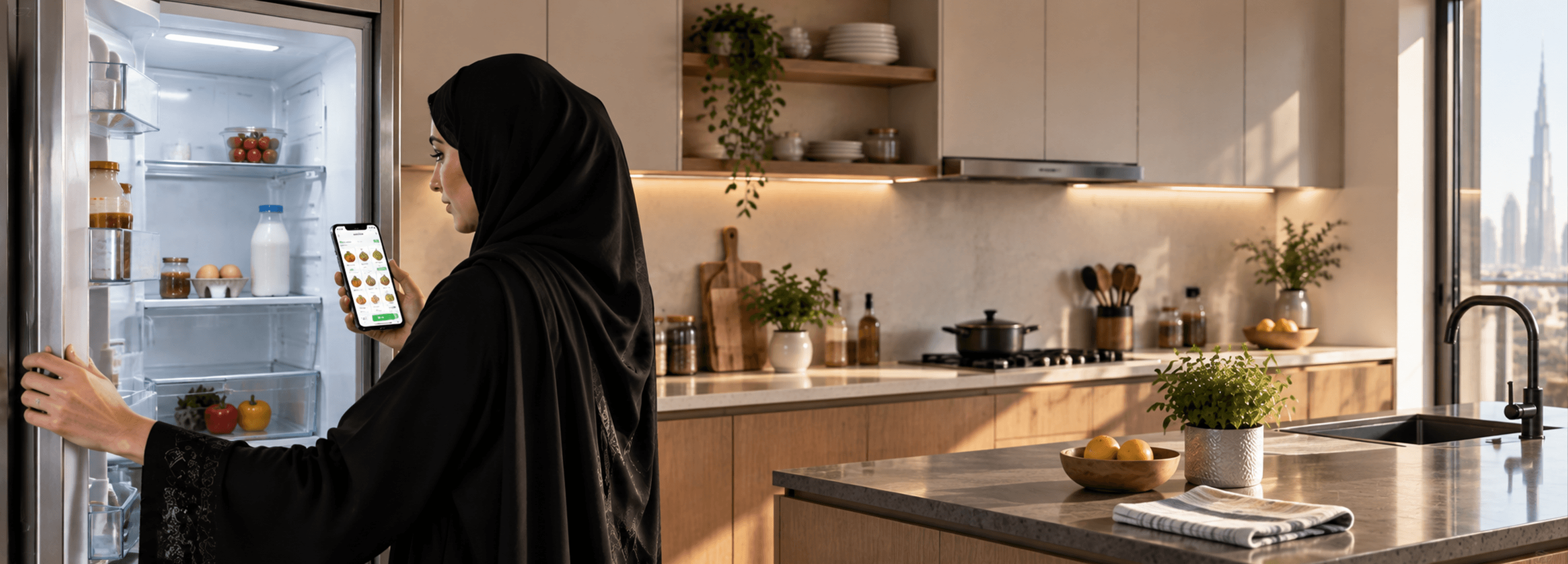
A listing for a piece of clothing or an electronic device can remain the same online for weeks and still be accurate. Grocery doesn't get that luxury. Prices change hourly, and the kilogram of produce a customer pays for at checkout rarely matches the exact kilogram that gets picked and delivered. That difference is often what decides whether a customer comes back
This guide walks through why online grocery store development in the UAE matters, what a grocery platform has to handle, and how to choose one.
73% of UAE shoppers already buy groceries online, and the online FMCG market grew 26.4% in the second quarter of 2026 alone (according to NielsenIQ). This trend creates a serious problem for traditional grocery stores that don’t provide their services through a digital marketplace.
Going online gives a grocery brand:
A grocery brand that goes online today starts earning customer trust before a competitor who waits, and every week spent offline lets that competitor's head start grow.
These are the areas where a grocery platform has to work differently from a standard eCommerce build:
In a grocery inventory, one SKU could be in multiple warehouses or fulfillment centers with varying stock levels, expiry dates, and restocking schedules. The moment a customer chooses a product that is unavailable at their preferred location, they are faced with delays or cancellations.
That is why multi-source inventory is important. Good warehouse-level inventory management enables real-time inventory visibility, allowing the product page to reflect true stock levels at a warehouse or distribution center and accurately communicate product availability at checkout. It is the foundation of any modern grocery commerce platform.
Quick commerce has changed what grocery shoppers expect. Same-day and 15-minute delivery commitments have become the norm, and a platform that does not support slot-based delivery at checkout is already losing out to those who do.
Grocery delivery app development has to account for real-time integration with fleet management or third-party logistics providers, showing only the slots that are actually fulfillable from the nearest warehouse, and updating those slots as capacity fills up.
Grocery pricing doesn't work on a one-unit, one-price model. Produce that is loose is priced by the weight, and it can vary considerably from what was initially ordered and bagged, resulting in a different price than expected.
A reliable grocery eCommerce site needs variable-weight pricing built into the product and checkout flow, along with clear logic for how price adjustments get communicated to the customer after picking.
A system should allow for product substitutions in the case of an out-of-stock situation during the order process.
This requires having a mechanism in place, backed by a strong order management system, that allows for partial order fulfillment and keeps the customer updated about the status of their order at all times.
Mobile now drives close to 79% of all UAE eCommerce transactions. A seamless mobile commerce experience enables customers to reorder their weekly staples with just a tap in the middle of their daily activity and complete the process within a short timeframe.
A grocery site built for this has to work with one thumb. Search needs to be quick to scan, reordering past purchases should take a single tap, and checkout has to be fast enough to finish while waiting for a lift or standing in a queue.
UAE grocery shoppers are jumping on the buy-now-pay-later trend that includes services such as Tabby and Tamara, while COD adoption continues to fall. A grocery platform built around COD as the default is already behind where its customers actually are.
Card, BNPL, and COD all still need to work cleanly at checkout, but the platform should be built assuming digital payment is the primary path, since grocery is a repeat-purchase category where friction at payment has a huge effect on whether a customer comes back for their next order or not.
The operational requirements above show what a platform needs to be configured for. Adobe Commerce (Magento) and Shopify Plus can both support these needs, but the specific details have to be designed for directly:
Shopify Plus suits any grocery brand running out of one or two locations with a leaner catalog, especially one launching its first online store and wanting to move quickly. It's fully hosted, so traffic spikes and scaling come with less operational overhead, and its native and app-based capabilities can meet real-time inventory and delivery-slot needs without a large technical team behind it.
Adobe Commerce (Magento) fits a grocery business managing multiple warehouses with a high-SKU catalog spanning fresh, packaged, and imported categories. Its multi-source inventory model was built for this kind of multi-location complexity, and it supports catalog growth without a hard ceiling. It needs a capable technical team to configure and maintain, and that investment pays off once substitution logic and weight-based pricing get complex enough to require deep customization.
Codilar has helped brands like Gulf Fruits grow orders by 64% through platform work across food and beverage, jewellery, fragrance, and manufacturing.
That same evaluation discipline carries into grocery: understanding the operational reality first, then matching it to the platform that actually supports it. Backed by an experienced team and ongoing support, your brand gets a partner who stays involved well past launch.
So if you're planning a grocery eCommerce development in the UAE, talk to Codilar's experts now to scope the right platform for your business, and turn it into an online store your customers keep coming back to.
It depends on the brand’s specific needs. Shopify Plus is suitable for businesses with a limited area and staff. Adobe Commerce (Magento) is more appropriate for companies with a larger catalog, several warehouses, and more complicated pricing and fulfillment structures.
The eCommerce platform must be integrated with the company's POS, ERP, warehouse, or inventory management software to relay messages pertaining to stock levels to synchronize between the brand's different locations. This ensures that products that are already sold out will not be put on the website and facilitates automated inventory management instead of having to do it manually.
Yes. A grocery store can be configured to show delivery slots based on warehouse availability, delivery capacity, and location. It should also support substitution preferences, partial fulfillment, and customer notifications when an ordered product is unavailable.
The cost depends on the size of your catalog, the number of warehouses you want to integrate into the system, the level of integration, the delivery model, the payment methods, and the degree of personalization of the solution. For an accurate estimate, get in touch with Codilar's team with your specific requirements.

Get tailored technology solutions to scale your retail business online
Request A Quote

Stay ahead with insights, trends, and brand success stories from the world of Digital Commerce.


DTECH, Techno Hub 1, Dubai Silicon Oasis Authority, United Arab Emirates - Dubai - United Arab Emirates

Level 1, Building 7, Zone A Airport road, Business Gate P.O Box 93597 Riyadh 11683, KSA.


Codilar Digital Pte Ltd, 68 Circular Road, #02-01, 049422, Singapore

7th Floor, Jupiter Block Prestige Tech Park, Kadubeesanahalli, Bellandur Amtankere, Bengaluru, Karnataka 560103

Satrio Tower, Floor 6, Unit C and D, Desa/Kelurahan Kuningan Timur, Kec. Setiabudi, Kota Adm. Jakarta Selatan, Provinsi DKI Jakarta