





Shopify
Shopify Canvas is Live: What It Can Handle and What It Cannot
Nikki Kumari|Oct 6, 2026|Read 8 Min




In 2019, headless commerce was a buzzword. But now, it's a competitive necessity. The brands growing fastest, the ones with lightning-fast storefronts, seamless omnichannel journeys, and checkout experiences that feel embedded to every device are the ones that made the move to headless commerce architecture.
But here's what the trend pieces don't tell you!
Headless commerce isn't just a technical upgrade. It's a business strategy decision.
And if you don't understand what you're getting into, it can be an expensive experiment rather than a growth lever. So, this blog breaks down the real headless commerce advantages and gives you the honest picture of when it makes sense for your eRetail business.
In a traditional eCommerce setup, your frontend (what customers see) and your backend (catalog, orders, payments) are tightly coupled.
Change one, you risk breaking the other. Want a new mobile experience? You're constrained by what your platform's theme engine allows.
Headless commerce separates the two.
The frontend is built with modern frameworks like React, Next.js, or Vue.js that communicates with the backend via APIs. This means you can build any experience you want on any channel, without touching the commerce logic underneath.
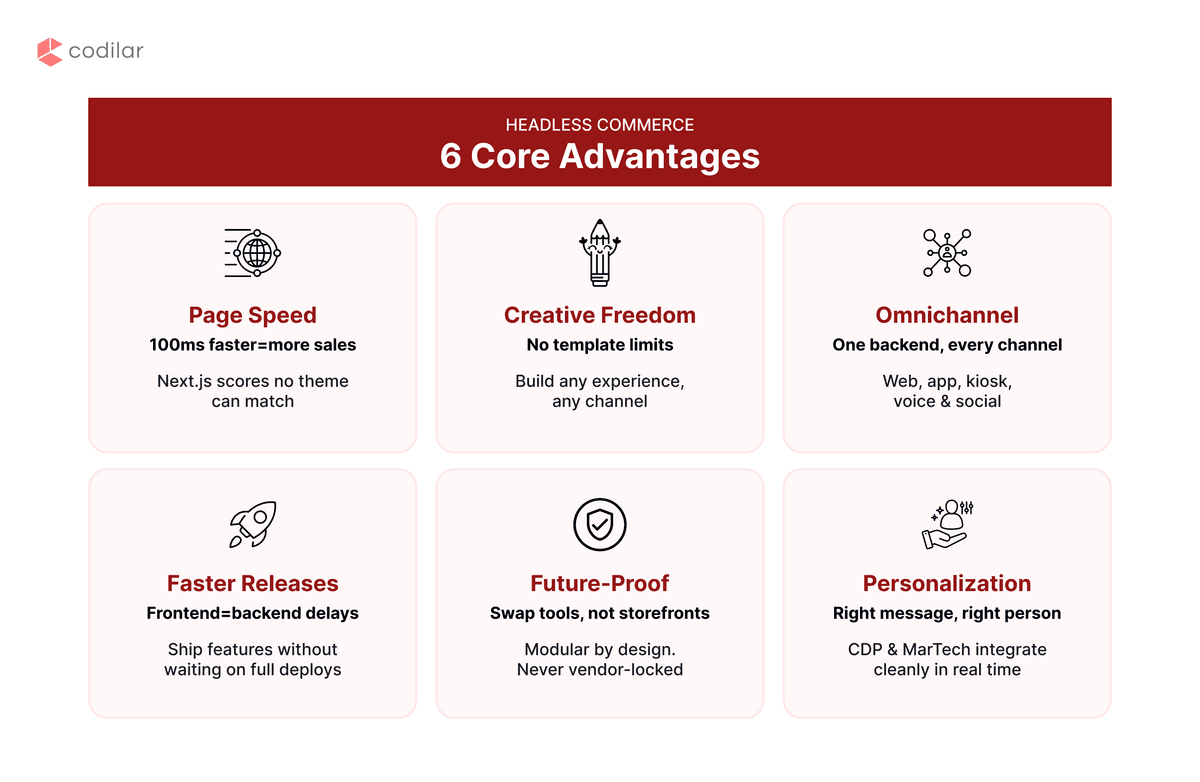
Here are the major headless commerce benefits that can help your storefront grow faster and bigger.
The single biggest measurable advantage of headless architecture is performance. Traditional eCommerce platforms carry significant frontend bloat. Headless storefronts built on Next.js or similar frameworks achieve Core Web Vitals scores that traditional themes simply can't match. And the data is clear. Every 100ms improvement in load time correlates to a measurable conversion lift.
With headless, your design team isn't constrained by theme templates. You can build pixel-perfect brand experiences, complex interactive product configurators, immersive editorial pages like anything. Fashion brands, luxury retailers, and B2B companies with complex catalogs particularly benefit from this freedom.
One backend powering your website, mobile app, in-store kiosk, voice interface, and social commerce- that's the headless promise. Your inventory, pricing, and customer data stay consistent across every touchpoint. Codilar has helped brands achieve this exact architecture at scale.
As the frontend and backend are decoupled, your headless commerce development teams can work in parallel. A new checkout flow doesn't require a backend release. A new homepage design doesn't need backend testing. Speed to market improves dramatically.
Swap your CMS, upgrade your commerce platform and add a new payment provider- all without rebuilding your storefront. Headless architecture is inherently modular. You're never locked into one vendor's roadmap.
Headless storefronts integrate more cleanly with personalization engines, CDPs, and marketing automation tools. You can serve different content, product recommendations, and pricing to different customer segments.
Headless is genuinely transformative for brands that have outgrown their platform's frontend capabilities, need to deliver experiences across multiple channels, have development teams capable of owning a React/Next.js codebase, or are competing in markets where speed and personalization are table stakes.
If you're a small store with a single channel and a small team, headless may be more complex than value right now. The honest answer is- it depends on where you are in your growth journey.
Codilar helps brands make this assessment before committing to an architecture.
Brands that migrate to headless commerce with the right partner consistently see meaningful improvements across the key metrics that drive revenue. Core Web Vitals scores in the 'Good' range, mobile conversion rate improvements, faster time-to-market for new features, and reduced frontend development cost over time due to component reuse.
Codilar is one of India's most experienced headless commerce implementation partners, with a team of 260+ eCommerce specialists and tech leads averaging 8+ years of platform experience. Their headless practice spans Adobe Commerce (Magento), Shopify Plus, and composable commerce architectures.
But what sets Codilar apart is that they don't just build the storefront, they architect the entire commerce ecosystem. From frontend performance to backend API design, from SEO preservation to MarTech integration, Codilar delivers headless commerce that is fast, scalable, and revenue-driven. However, if you’re facing platform limitations like wanting more UI/UX features to apply to your storefronts and more, we at Codilar being the leading headless commerce agency in the GCC can also guide you through the seamless migration to headless architecture. Connect with us today!
Headless commerce is highly effective for brands focused on speed, flexibility, and better user experience. It consistently drives higher conversions by improving performance, personalization, and faster rollout of features.
Headless is ideal for growing brands that need flexibility, omnichannel presence, and faster innovation. For smaller stores with simple needs, it may add unnecessary complexity without immediate ROI.
Headless separates the frontend from the backend, allowing complete control over how your storefront looks and performs. It’s used to deliver faster, more customized experiences without being limited by platform constraints.
Headless commerce is an architecture where the frontend and backend operate independently, connected through APIs. This setup allows businesses to build high-performance, flexible storefronts across multiple channels.

Get tailored technology solutions to scale your retail business online
Request A Quote

Stay ahead with insights, trends, and brand success stories from the world of Digital Commerce.


DTECH, Techno Hub 1, Dubai Silicon Oasis Authority, United Arab Emirates - Dubai - United Arab Emirates

Level 1, Building 7, Zone A Airport road, Business Gate P.O Box 93597 Riyadh 11683, KSA.


Codilar Digital Pte Ltd, 68 Circular Road, #02-01, 049422, Singapore

7th Floor, Jupiter Block Prestige Tech Park, Kadubeesanahalli, Bellandur Amtankere, Bengaluru, Karnataka 560103

Satrio Tower, Floor 6, Unit C and D, Desa/Kelurahan Kuningan Timur, Kec. Setiabudi, Kota Adm. Jakarta Selatan, Provinsi DKI Jakarta