





General
StyleSmuggler (CVE-2026-75650): Security Alert for Adobe Commerce and Magento Open Source Stores
Nikki Kumari|Sep 15, 2026|Read 5 Min




Most UAE manufacturers still close deals the same way: a distributor calls in the usual order, a buyer messages on WhatsApp, and a sales rep follows up by phone, but the buyer on the other end already checked them out first.
Buyers now research a manufacturer online. They check the website and browse the product range, often comparing it against a competitor's site before ever picking up the phone or sending that message. By the time the call happens, a buyer has usually already judged the manufacturer by their website.
This is why eCommerce website development for manufacturers in the UAE has become a priority.
Manufacturers with no website at all are invisible to anyone outside their existing network. A buyer without an inside contact has no way to find them or confirm they actually make what's needed.
Manufacturers who do have a site but haven't touched it in years face a quieter version of the same problem. Outdated product photos, discontinued items still listed, and missing certifications or specs all make the business look less reliable than it is.
A buyer weighing two similar manufacturers trusts the one whose website answers their questions today.
This trust gap starts the moment a buyer actually lands on the page.
Once a buyer lands on a manufacturer's website, they're checking:
Answering these clearly on the page moves a buyer toward a call or an RFQ (request for quote), and in a competitive market, this extra step often decides who gets the order.
A working B2B eCommerce platform changes how a manufacturing business sells:
Getting there takes a platform built around tiered pricing and made-to-order timelines.
Advanced search and filteringProcurement teams search by material grade, tolerance, certification, or part number, and expect to land on the right product in a couple of clicks. The manufacturing site needs filtering built around these technical attributes, down to the exact spec a buyer is looking for.
Product configurator
A number of manufactured products cannot be sold as is. That means before estimating the selling price of such items, a buyer should choose the necessary options and settings, be it materials, size, colors, or technical specifications. An online configurator helps to get an up-to-date estimate of the purchase immediately after selecting the desired attributes.
ERP integration
A website showing different stock levels or pricing than what's actually in the warehouse damages buyer confidence fast. ERP integration syncs inventory, pricing, and order status between the systems running the factory and the website buyers see.
Centralized product data
Manufacturers often manage the same product information across multiple channels: the website, distributor portals, spec sheets, and certification documents. A PIM system centralizes this data so the spec sheet and the website always match.
Mobile-optimized buyer portal
Procurement managers check stock, reorder routine items, and track shipments from their phones just as often as from a desk, especially when managing multiple suppliers on the move. A properly optimized mobile commerce portal makes this genuinely usable, with the same functionality as the desktop site.
RFQ and approval workflows
Custom quantities, non-standard specifications, or high-value orders often need a formal request-for-quote process and internal sign-off before confirmation. This keeps non-standard purchases moving without forcing every order through a rigid checkout flow.
The right platform depends on how complex the buying process is.
Adobe Commerce fits manufacturers managing large technical catalogs, multi-tier distributor pricing, or operations across several regions. It handles deep, rule-based product configuration, connects naturally with Pimcore for centralized product data, and supports multi-storefront setups for manufacturers running several brands or regions from one backend. It also has more flexibility for custom or legacy ERP integrations, which suits established manufacturers with systems already built around older infrastructure.
Shopify Plus is suitable for mid-market manufacturers in the UAE that want to avoid the implementation time of an enterprise system while still providing buyers a positive experience. The platform offers B2B company accounts, standard ERP integration, self-serve ordering with net payment terms, and RFQ workflows without the cost and complexity of an enterprise-level solution.
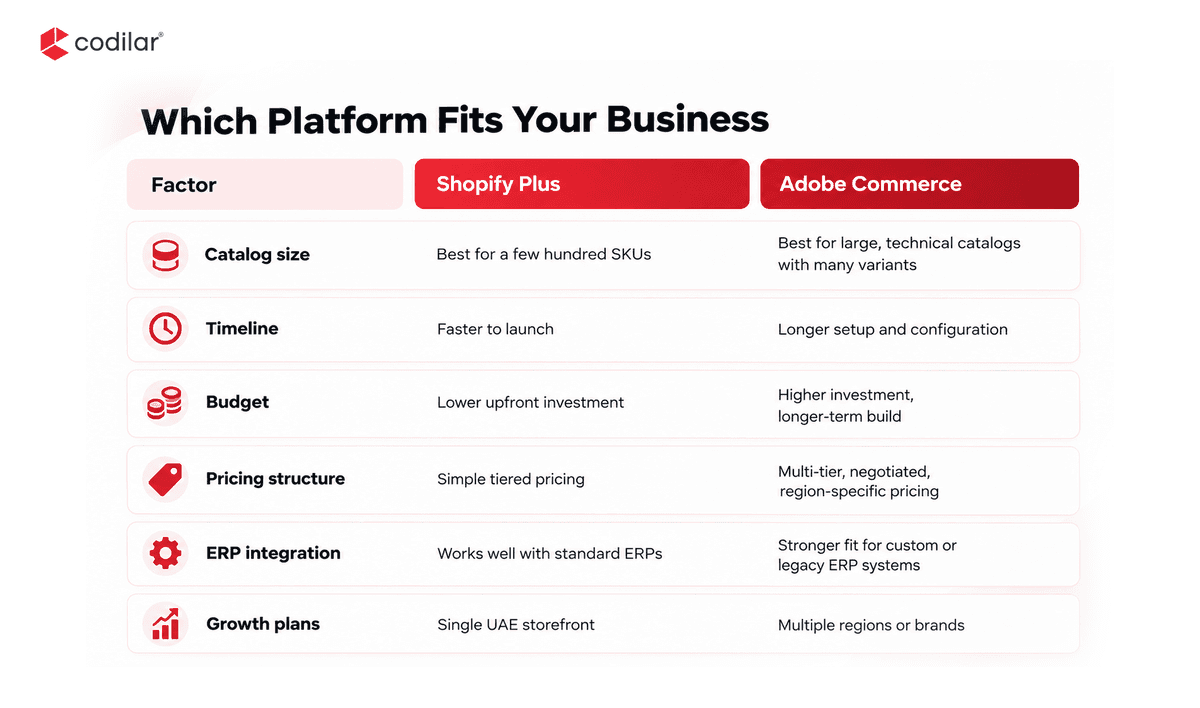
Codilar works with manufacturers across both platforms, and a quick consultation is the easiest way to land on the right one.
A manufacturing website isn't just a sales channel in the UAE. It also has to meet the country's own tax and data rules.
A compliant manufacturing eCommerce platform needs to handle:
A platform that can't handle these automatically turns every sale into a manual, error-prone process.
A manufacturing website that doesn't answer a buyer's questions, or doesn't exist at all, is quietly costing deals before a single call happens.
A good manufacturing site should be organized around manufacturing’s selling process: technical cataloging, varying pricing levels, ERP connection, and the types of compliance specific to a market, which drives leads to buyers.
So if your current website isn't doing that work, or there isn't one yet, a short conversation with Codilar's team is a great starting point!
Buyers should be able to easily find products, technical specifications, certifications, and RFQ or contact options. For UAE manufacturers selling internationally, showing export markets and delivery capabilities helps too.
Yes, it can. An eCommerce site can connect to an ERP in order to synchronize information about products, inventory, pricing, customer orders, and accounts. The exact integration depends on the ERP and the manufacturer's existing systems.
The website should be able to offer different prices depending on the customer’s account or contract. It will be beneficial for manufacturers who work with business customers and dealerships and provide them with exclusive pricing.
Yes. You can set up an RFQ workflow that would capture product specs, quantity, and destination information before submitting an inquiry to your sales team.
If the business falls within the UAE's e-invoicing requirements, its commerce and financial systems need to support them. The programme is being introduced in phases, with mandatory implementation beginning in 2027, depending on the business.

Get tailored technology solutions to scale your retail business online
Request A Quote

Stay ahead with insights, trends, and brand success stories from the world of Digital Commerce.


DTECH, Techno Hub 1, Dubai Silicon Oasis Authority, United Arab Emirates - Dubai - United Arab Emirates

Level 1, Building 7, Zone A Airport road, Business Gate P.O Box 93597 Riyadh 11683, KSA.


Codilar Digital Pte Ltd, 68 Circular Road, #02-01, 049422, Singapore

7th Floor, Jupiter Block Prestige Tech Park, Kadubeesanahalli, Bellandur Amtankere, Bengaluru, Karnataka 560103

Satrio Tower, Floor 6, Unit C and D, Desa/Kelurahan Kuningan Timur, Kec. Setiabudi, Kota Adm. Jakarta Selatan, Provinsi DKI Jakarta