




General
eCommerce Website Development for Pet Care Brands in the UAE
Aakash Ashok|Oct 16, 2026|Read 8 Min



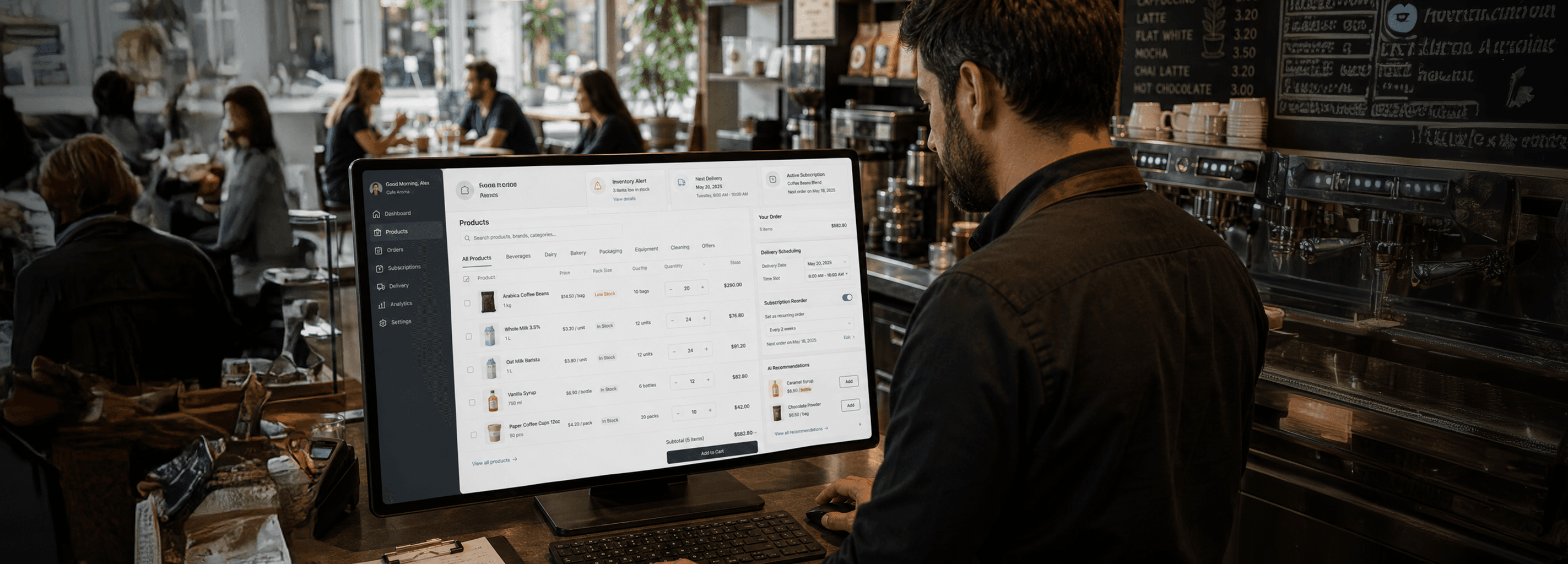
Buying food online has gone from a convenience to a habit for millions of households across the US, Europe, and Asia. Shoppers are no longer just ordering groceries out of necessity, but are subscribing to specialty coffee roasters, discovering new brands through TikTok or social commerce videos, and expecting their orders at the door the same day.
Latest: "The global F&B eCommerce market is projected to reach $894.68 billion in 2026, growing at a 16.9% CAGR. For brands without a high-performing digital store, that growth belongs entirely to someone else."
Food and beverage eCommerce website development in 2026 involves far more than listing products and setting up a checkout. Compliance requirements, subscription mechanics, AI-driven personalization, and same-day delivery infrastructure are now part of the foundation, not the upgrade path. Check this guide to understand what platform fits your brand's model, what features separate high-converting food stores from average ones, and what it genuinely takes to build an eCommerce presence that grows with your business.
Food and beverage is the fastest-growing eCommerce category in 2026, and the dynamics behind that growth are influencing every brand building an online store currently.
Social commerce has become a primary discovery engine for food brands with TikTok Shop driving nearly 20% of US social commerce in 2026, with video content capturing over 43% of the total social commerce market. Meanwhile, D2C food brands are growing at 15.4% annually, and the economics favor them significantly. With the lowest customer acquisition cost of any D2C category at $45 to $53 per customer, and returning customers generating 60% of brand revenue, the F&B model rewards brands that build for retention.
Then there is compliance. The FDA Food Traceability Rule, effective January 2026, requires enhanced tracking systems for certain food categories across the entire supply chain. This is not a bolt-on requirement, but has to be embedded into how a brand builds its product data architecture and eCommerce infrastructure. This makes the platform and tech stack decisions that follow even more consequential than they were before.
Platform selection for food and beverage eCommerce is fundamentally different from any other retail category. Perishable logistics, subscription billing, age verification for alcohol, and FDA traceability compliance all need to be supported at the platform level. The best eCommerce website for food and beverage brands is the one built around these operational realities.
The strongest platform for most food brands to start with in 2026. Shopify Plus supports native subscription integrations through Recharge and Bold, handles age verification for alcohol brands, and carries the largest food-specific app ecosystem of any platform available today. Shopify food stores convert at 2.3%, the highest rate on the platform across any category.
Built for food manufacturers managing large catalogs, B2B wholesale and D2C simultaneously, and deep ERP integrations. Adobe Commerce (Magento) provides complete control over compliance data architecture, but requires a dedicated technical team to operate effectively.
MACH architecture allows food brands to swap out individual components, including payment gateways, CMS, and recommendation engines without disrupting the complete system. This is the right choice for brands operating across web, app, and in-store screens simultaneously.
Free eCommerce website options for food brands exist through Shopify's free themes and open-source Magento. Both provide a zero-license starting point, though compliance integrations, subscription tooling, and hosting costs apply regardless.
Food and beverage eCommerce carries requirements that no other retail category deals with. Below are the features that a F&B brand cannot afford to compromise with:
For F&B eCommerce websites, structured and verified product data powers all of these features. Ingredients, nutritional values, certifications, allergens, and sourcing details must be accurate and machine-readable, both for AI-driven discovery and for FDA traceability compliance.
Food is a sensory category being sold through a screen. The brands that convert best are the ones that close that gap through photography, video, and design that communicates taste, freshness, and quality before a shopper reads a single word of copy.
Recipe content and usage suggestions embedded directly on product pages reduce the hesitation that is unique to food buying online. A shopper who can see how a product is used, what it pairs with, and what others say about it moves through the purchase journey with far less friction than one left to imagine it.
Mobile is where most food discovery and impulse purchasing happens. Thus, frictionless add-to-cart, one-tap subscription signup, and fast reorder flows are the baseline for mobile CRO. Meanwhile, transparency is equally important, including ingredient lists, sourcing details, and certifications must be visible without requiring the shopper to search for them. A store that makes customers dig for information they need to feel confident is creating avoidable friction at exactly the wrong moment.
Recipe content is the most underleveraged SEO asset in food eCommerce. A single well-structured recipe page targeting a high-intent query ranks in organic search, earns AI citations, and links directly back to the product featured in it.
In 2005, Food and Drink saw the fastest growth in AI Overview triggers of any eCommerce vertical, with up to 50% of certain query types now generating AI-answered results. Generative Engine Optimization (GEO) determines whether your brand appears in those answers. Product schema covering ingredients, allergens, nutritional values, and certifications is the entry point. Without it, AI systems cannot reliably surface your products when a shopper asks a dietary or ingredient-specific question.
On performance, food sites are structurally image-heavy and LCP failures on product pages directly suppress both rankings and conversion rates. Switching to AVIF format, preloading hero imagery, and serving assets through a CDN resolves the most common bottlenecks without requiring a platform rebuild.
Also Read: https://www.codilar.com/how-ai-search-engines-sge-change-ecommerce-seo/
Not sure where your food store is losing customers? Codilar's team will help you find out, and show you exactly how to fix it.
Food and beverage eCommerce is operationally more complex than most retail categories. This includes perishable inventory having expiration dates, cold-chain logistics failing at any handoff, and subscription billing requiring to be flexible enough to handle pauses, swaps, and cancellations without losing the customer. Each of these requires a specific integration, and the cost of getting any one of them wrong shows up directly in returns, churn, or compliance failures.
Subscription billing through Recharge or Bold handles the recurring revenue layer, but the real retention work happens in the data. Klaviyo's predictive models identify customers approaching churn based on order patterns and trigger personalized replenishment nudges before the cancellation decision is made. For food brands where a median subscription delivers 15% higher AOV year-over-year than one-time purchases, keeping that subscriber active is worth more than acquiring a new one.
For brands managing both B2B wholesale and D2C simultaneously, an OMS connected to the ERP is what prevents overselling and fulfillment failures across channels. FDA traceability compliance, effective January 2026, adds batch tracking and IoT sensor data to that stack.
Food and beverage converts at 4% to 6%, which is the highest rate of any eCommerce category. Factors affecting brands’ position comes down to four specific mechanics.
The food and beverage brands building a serious digital presence in 2026 are considering platform, compliance, subscription infrastructure, SEO, and CRO as one connected system. The window for building that foundation is narrowing as AI agents take on more of the discovery process and consumer expectations around delivery, personalization, and transparency continue to rise.
Codilar Technologies has spent years building and scaling food and beverage eCommerce stores for global brands, with over 240 specialists working across Magento, Shopify Plus, AEM, CRO, and performance hosting. For F&B brands serious about getting every layer right simultaneously, that depth of cross-platform experience is what turns a well-researched strategy into a store that actually performs.
Your brand never settles, so your food and beverage eCommerce store shouldn’t either. Talk to a Codilar’s experts today.
The best eCommerce platform for food and beverage brands depends on the business model, operational complexity, and growth stage. Shopify Plus is ideal for D2C food brands focused on subscriptions, rapid scaling, and faster go-to-market execution. Adobe Commerce (Magento) works better for enterprise food businesses managing B2B, D2C, ERP integrations, and large product catalogs simultaneously. Brands operating across multiple touchpoints often choose headless commerce architectures for greater flexibility and scalability.
A high-performing food and beverage eCommerce website should include subscription billing, allergen and dietary filtering, AI-driven product recommendations, scheduled delivery options, bundle builders, mobile-first checkout experiences, and structured product data. Moreover, features like recipe integration, real-time inventory visibility, and cold-chain delivery tracking are also becoming essential for improving conversions and customer retention in 2026.
Food brands can improve eCommerce SEO by optimizing recipe content, implementing product schema markup, improving Core Web Vitals, and structuring ingredient and nutritional data for AI search visibility.
Conversion Rate Optimization (CRO) directly impacts customer acquisition efficiency, repeat purchases, and subscription growth for food and beverage brands. High-converting food stores focus heavily on delivery transparency, mobile-first UX, real-life product imagery, faster checkout experiences, and subscription-first purchase flows.
Subscriptions help food and beverage brands increase customer retention, improve recurring revenue, and boost customer lifetime value. Features like flexible delivery frequency, pause-and-skip options, and personalized replenishment flows are now essential for D2C food brands.
Essential workflows for a food & beverage eCommerce site include inventory and expiry management, subscription and auto-replenishment, cold chain and fulfillment routing, regulatory and labeling compliance, seasonal and flash sale automation, and post-purchase engagement triggers. Together, these workflows keep operations efficient, orders accurate, and customers coming back.

Get tailored technology solutions to scale your retail business online
Request A Quote

Stay ahead with insights, trends, and brand success stories from the world of Digital Commerce.


